

Anthropology Answer Writing: The 5-Part Structure Toppers Use in Mains
If you have ever walked out of the anthropology paper thinking “I knew everything, so why did the answers feel so messy?”, you are not alone. Most aspirants don’t lose marks because they lack content. They lose marks because the content is dumped on the page with no shape.
Toppers do something different, and it is surprisingly simple. Almost all of them follow a loose five-part structure, even if they never call it that. Once you see it, you can’t unsee it.
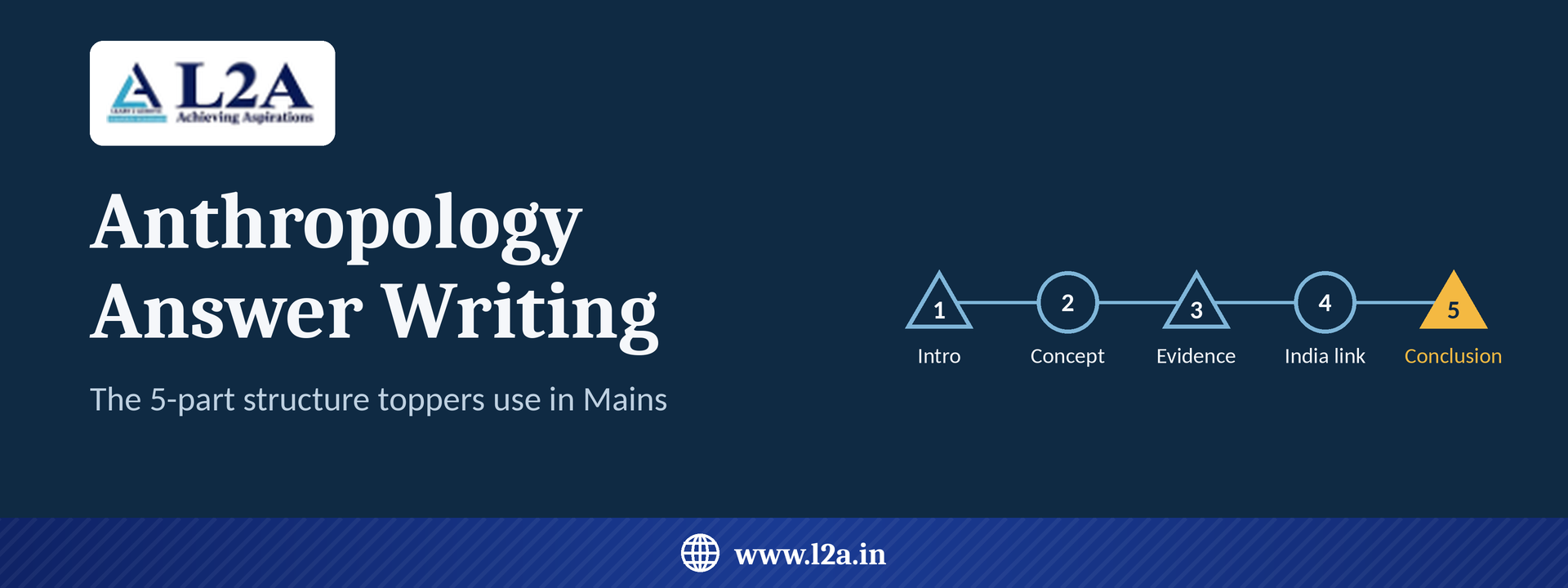
Quick answer: A strong anthropology answer in Mains usually has five parts: a crisp introduction, the core concept or theory, supporting evidence (thinkers and ethnographies), an Indian or contemporary link, and a balanced conclusion. Keep the flow tight, use diagrams where they help, and stay inside the word limit.
Why structure matters more than you think
Anthropology is a content-heavy optional. Between Paper I and Paper II you are juggling theories, tribes, thinkers, committees and case studies. An examiner reading hundreds of copies in a day doesn’t have time to hunt for your point.
A predictable structure does two things. It makes your answer easy to read, and it stops you from forgetting half of what you know under exam pressure. Think of it as a template your brain can fall back on when the clock is running.
What examiners actually look for
From what toppers and mentors consistently say, the checklist is short:
- Did the answer address the exact demand of the question (discuss, critically examine, comment)?
- Is the anthropological vocabulary correct?
- Are there real examples, not just generalisations?
- Is there some original linking or analysis, even a line or two?
The five-part structure below is built around exactly these things.
The 5-part structure, step by step
Part 1: A crisp introduction (2–3 lines)
Don’t write a mini essay here. Define the key term or set the context and move on. If the question is on functionalism, one line on what it is and one line on who gave it is enough.
A good trick is to start with a definition from a recognised thinker, or with the discipline’s own framing, such as the holistic and comparative nature of anthropology. It signals that you are thinking like an anthropologist from the first line.
Part 2: The core concept or theory
This is the spine of your answer. Explain the idea in plain language first, then add the technical terms. For example, if you are writing on Malinowski, explain that culture exists to meet human needs, and then bring in terms like biological needs and derived needs.
Keep it to a few short points or a small paragraph. If a flowchart or a simple diagram explains it faster than words, draw it. Diagrams save time and the examiner remembers them.
Part 3: Evidence, thinkers and ethnographies
Here is where average answers and good answers separate. Don’t just name a thinker. Connect the thinker to the argument.
Instead of “Radcliffe-Brown also gave a view”, write what the view was and how it differs from the earlier one. Use fieldwork where you can: Trobriand Islanders for Malinowski, Andaman Islanders for Radcliffe-Brown, and so on. One well-used ethnographic example is worth more than five names listed in a row.
Part 4: The Indian or contemporary link
This is the part most students skip, and it is often the part that earns the extra marks. Anthropology in India has a rich body of work, and linking your answer to it shows depth.
Depending on the question, you can draw on Indian tribal communities, village studies, caste and kinship research, tribal development policy or even current debates around identity and rights. Keep it relevant. A forced example is worse than none.
Part 5: A balanced conclusion
Close the loop. Sum up your position in two lines, mention one limitation or criticism if the question allows, and, if you can, end with a forward-looking thought. Avoid grand statements. A calm, balanced ending reads as maturity.
A quick example of how it looks on paper
Say the question is: “Critically examine the functionalist approach in anthropology.” (a typical 15-marker)
- Intro: Functionalism views society as an integrated system where every institution serves a purpose.
- Core idea: Malinowski’s need-based functionalism versus Radcliffe-Brown’s structural-functionalism.
- Evidence: Kula ring and magic among Trobriand Islanders; social structure and kinship in the Andamans.
- Indian link: Use of functional analysis in village and caste studies in India, along with the criticism that it ignores change and conflict.
- Conclusion: Useful for understanding how institutions hold together, but limited in explaining change, which later approaches tried to address.
Notice that nothing here is fancy. It’s just organised.
Common mistakes that cost marks
Writing everything you know
The urge to show off is real, but the examiner is grading relevance, not volume. Answer the question that was asked.
Ignoring the directive word
“Discuss”, “critically examine” and “comment” are not the same thing. A critical question needs a critique, not a summary.
Skipping the conclusion because time ran out
Even a one-line ending is better than none. If time is short, cut a detail from Part 3, not the conclusion.
Overloading with jargon
Technical terms are good. Jargon that you can’t explain is not. If you can’t define it in a line, leave it out.
How to practice this without burning out
You don’t need a hundred answers a week. You need a routine that sticks.
- Pick one previous year question a day.
- Write it in the real time limit, with the five parts in mind.
- Compare it with a topper copy or a trusted mentor’s feedback, not to copy but to notice gaps.
- Keep a small notebook of ready-to-use examples, thinkers and Indian studies so you aren’t hunting for them in the exam.
- Revise your best answers once a week.
After two or three weeks, the structure stops feeling like a rule and starts feeling like your natural writing style.
Frequently asked questions
Is the 5-part structure compulsory for every anthropology answer?
No. It’s a flexible framework. Short 10-markers may compress it into three parts, while 20-markers can stretch it. What matters is that your answer has a clear beginning, a substantial middle and a clean ending.
How many diagrams should I add?
Only where they genuinely help. One or two good diagrams in a paper is better than forcing one into every answer.
Should I always include an Indian example?
Whenever it fits naturally, yes. Many Paper II questions practically demand it, and Paper I answers often gain from it too.
How long does it take to get comfortable with this?
Most aspirants feel a clear difference in two to three weeks of daily practice, though it varies from person to person.
Can I use this structure for tests and not just the final exam?
Absolutely. In fact, test series are the best place to build the habit.
Final thoughts
Good answer writing in anthropology isn’t about knowing more than everyone else. It’s about presenting what you know in a way that an examiner can follow in about two minutes. The five-part structure gives you that discipline: define, explain, support, localise, conclude.
Start with one answer today. Time yourself, follow the five parts, and see how it feels. Then do it again tomorrow.