

Anthropology Optional 2027: The Complete Roadmap for UPSC Aspirants
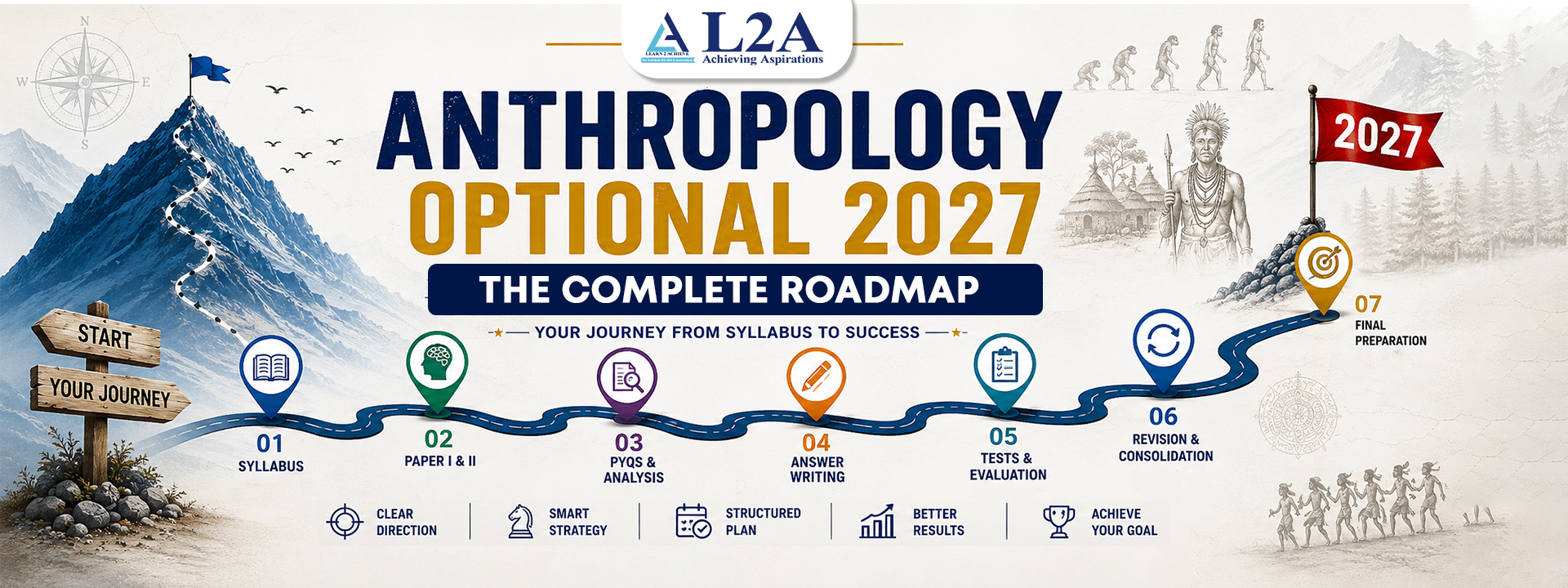
If you've just decided to take Anthropology as your optional for UPSC 2027, you're probably staring at the syllabus right now wondering where to even begin. That's normal. Anthropology looks compact compared to some other optionals, but the moment you open the syllabus properly, you realise there's a lot packed into those two papers — biological concepts, social theory, tribal India, and current affairs all mixed together.
This isn't another "complete guide" that lists out books and topics and leaves you to figure out the sequence yourself. It's a roadmap built around one question that most students actually ask at every stage of their preparation: what should I do next? Whether you've just picked Anthropology as your optional, finished Paper I, or are staring down Prelims with Paper II still incomplete — this article is meant to tell you the next step, not just what exists to study.
The Anthropology Optional Syllabus — Your Starting Point
Before anything else, print the official UPSC syllabus and keep it in front of you. Not a summarised version from some website — the actual syllabus. Anthropology Optional has four broad areas: Biological Anthropology and human evolution, Social-Cultural Anthropology, Indian tribes and society, and topics connected to constitutional safeguards and applied anthropology.
Once you've printed it, don't just read it and put it away. Turn every heading into a tracker. Literally write down each topic and leave space next to it to note when you first read it, when you made notes, and when you attempted a PYQ on it. This one habit alone will save you from the most common trap in optional preparation — studying without knowing how much ground you've actually covered.
The Right Order to Prepare Anthropology Optional for 2027
This is really the heart of the whole article, so let's slow down here.
Phase 1 — Build the Foundation
You don't start by buying five books. You start by understanding what you're even preparing for. In this phase:
- Go through the syllabus line by line so nothing feels unfamiliar later
- Get comfortable with basic anthropological terms — you'll be using them constantly
- Start Paper I first, since it builds the conceptual base for everything else
- Make short notes as you go, not after finishing a whole unit
- Keep Previous Year Questions next to you from day one — not to solve them yet, just to see how topics are actually asked
This phase is slow on purpose. Rushing here means you'll be re-reading basics six months later.
Phase 2 — Complete Paper I
Once the foundation feels steady, move through Paper I properly. The order that works best is conceptual clarity first, then the relevant theories, then the thinkers behind those theories, then diagrams, and only then PYQs on that topic.
One thing worth saying clearly: don't read three or four books for the same topic hoping for extra marks. It rarely helps and mostly just eats time. Pick one primary source per topic and stick with it.
Phase 3 — Complete Paper II
Paper II is where a lot of students go wrong because it feels more "story-like" — tribes, case studies, government schemes. The sequence that actually works is: Indian examples first, then tribal studies in depth, then case studies, then government programmes, and only after all this, bring in contemporary developments.
Current affairs should enter here, but selectively — not as a separate subject you study in isolation, but as something that gets attached to a static topic you already know.
Phase 4 — PYQ-Based Consolidation
By this point you've covered both papers at least once. Now go back topic by topic using this exact sequence: Syllabus → PYQ → Theme → Notes → Answer Framework. This phase is where scattered reading turns into something you can actually write an answer with.
Phase 5 — Answer Writing and Testing
This is the phase most students delay the longest, and it's usually a mistake. Move from untimed answers, to timed answers, to sectional tests, and finally full-length tests. If you look at how most serious 2027 aspirants are preparing right now, answer writing and testing aren't an afterthought — they're built into the plan from a fairly early stage. Treat them the same way.
Anthropology Optional Paper 1 Strategy
How to Study Biological Anthropology
This section rewards precision. Focus on human evolution, genetics, and primate studies, but don't just read them as text. Draw the diagrams yourself instead of just looking at printed ones — it sticks better. Build comparative tables for things like different hominin species or genetic concepts. The goal isn't memorising facts; it's being able to explain a concept clearly in an exam setting.
How to Prepare Social-Cultural Anthropology
Here the focus shifts to thinkers, their theories, and definitions. For every concept, know at least one real example that illustrates it — examiners reward answers that go beyond definitions. Comparisons between similar theories or thinkers also come up often, so keep a running list of "who said what, and how it differs from the other."
How to Prepare Anthropological Theories
Use this simple structure for every theory you study: Theory → Anthropologist → Core idea → Criticism → Example. This isn't just a reading method — it's practically the skeleton of an answer. If you prepare theories this way from the start, answer writing later becomes far less painful.
Anthropology Optional Paper 2 Strategy
Focus on Tribal India
Paper II leans heavily on tribal communities, so build real familiarity with specific tribal groups, their problems, developmental issues, and PVTGs (Particularly Vulnerable Tribal Groups). Also know the major government interventions aimed at tribal welfare — not just their names, but what they actually try to solve.
Connect Static Anthropology With Current Affairs
The strongest Paper II answers do this well: static topic + a recent development + an Indian example + an anthropological angle on it. Don't treat current affairs as a separate subject sitting outside your syllabus — it should always be pulled back into something static you've already studied.
Use Case Studies and Indian Examples
Case studies aren't decoration you sprinkle into an answer to make it look good. Used well, they're what separates an average answer from one that shows real understanding of ground realities.
Best Books and Resources for Anthropology Optional 2027
Here's the honest truth: you don't need a big library for this optional. A focused, limited set of sources — read properly, multiple times — beats a shelf full of books you've skimmed once.
Books for Paper 1
A commonly recommended set includes P. Nath, Ember & Ember, and Majumdar & Madan, along with concise class notes for quick revision. But don't just pick these because everyone else does — know why each one is useful.
- P. Nath works well as a foundational text covering most of the Paper I syllabus in one place
- Ember & Ember is particularly strong for biological anthropology and gives more conceptual depth
- Majumdar & Madan is useful for social-cultural anthropology theory
- Concise notes should be your revision tool, not your first read
Books for Paper 2
For Paper II, Nadeem Hasnain is widely used for Indian and tribal anthropology, alongside other Indian anthropology sources and select government or committee reports for the applied and policy side of the syllabus.
The point isn't to collect these books — it's to know which book covers which part of the syllabus, how much of it you actually need to read, and why it's worth your time over an alternative. That's what actually makes a difference, not the length of your reading list.
How to Make Notes for Anthropology Optional
Good notes for this optional follow the syllabus structure, not the order in which you happen to read things. Keep PYQs sitting right next to your notes on the same topic so you can see, at a glance, how that topic tends to be asked.
Build a separate diagram and example bank — this becomes gold during revision, because diagrams and real examples are usually what get skipped in a rushed final read-through. And eventually, condense everything into one-page revision sheets using this structure: Concept → Definition → Scholar → Diagram → Example → PYQ. Once you have these one-pagers for every topic, your last month of preparation gets a lot less stressful.
How to Use PYQs for Anthropology Optional
PYQs are probably the most underused resource in Anthropology preparation, mostly because students treat them as something to attempt at the very end. Use them earlier, in this order:
- Read the syllabus topic first
- Pull out PYQs from that exact topic
- Look for themes that repeat across years
- Understand what the question is actually demanding
- Build an answer framework around that demand
- Then actually practise writing it
One honest caveat here — PYQs don't guarantee that the same question will repeat. What they do reliably show you is the recurring themes, how questions get framed, and the level of application UPSC expects from you. That's valuable enough on its own.
Anthropology Optional Answer Writing Strategy
Structure Every Answer Around the Question Demand
Before writing anything, ask what the question is actually asking for — analysis, comparison, or description. Each demands a different structure.
Use Diagrams Where They Actually Add Value
Not every answer needs one. Use a diagram when it genuinely explains something faster than words would, not as a habit.
Add Anthropologists and Relevant Studies
Naming the right thinker or study at the right point signals depth of preparation to the examiner.
Use Case Studies in Paper II
Real examples make an abstract point concrete, and examiners notice this.
Keep the Answer Analytical
Description alone rarely scores well at this level — the analysis is what separates a good answer from an average one.
The core framework to build every answer around: Question Demand → Introduction → Core Concept → Scholar/Theory → Diagram/Example → Analysis → Conclusion.
Practise Anthropology answers with evaluation
Diagrams, scholars, and Paper II case studies only convert to marks when you write under time and get feedback — start with Test Series or Daily Answer Writing.
How to Balance Anthropology Optional With GS for UPSC 2027
Don't study your optional in complete isolation for months — it's a mistake that catches up with people later. Keep a parallel GS routine running throughout, and genuinely use the overlap between GS and Anthropology (tribal issues and constitutional safeguards overlap quite a bit, for instance). At the same time, protect your optional revision time — don't let GS quietly eat into it either.
A simple split that works for many students: mornings for GS, afternoons or evenings for Anthropology, and a short daily slot reserved for PYQs or answer writing. This isn't a rule carved in stone — adjust it to your own routine. What matters is that both subjects get consistent, protected time.
12-Month / Phase-Wise Anthropology Optional Roadmap for UPSC 2027
Rather than tying this to exact calendar dates, it's more useful to think in phases — this way the roadmap stays relevant no matter when you're starting your preparation.
|
Phase |
Focus |
|---|---|
|
Phase 1 |
Syllabus + Foundation |
|
Phase 2 |
Paper I |
|
Phase 3 |
Paper II |
|
Phase 4 |
PYQs + Notes Consolidation |
|
Phase 5 |
Answer Writing + Sectional Tests |
|
Phase 6 |
Revision + Full-Length Tests |
|
Phase 7 |
Prelims-focused period |
|
Phase 8 |
Post-Prelims Mains Revision |
Whatever month you're reading this in, find yourself on this table and start from there. That's the whole point of a phase-based roadmap over a rigid calendar.
Common Mistakes in Anthropology Optional Preparation
A few mistakes show up again and again among Anthropology aspirants, and most are avoidable:
- Starting preparation without actually reading the syllabus properly
- Collecting too many books instead of mastering a few
- Ignoring PYQs until the last few months
- Making notes so long they defeat the purpose of quick revision
- Delaying answer writing until it feels "too late" to start
- Treating Paper II like a GS subject instead of an anthropology one
- Adding current affairs without connecting it back to anthropological concepts
- Leaving revision for the very end instead of building it in gradually
If even three of these sound familiar, it's worth adjusting your plan now rather than in month ten.
How L2A Academy Can Help With Anthropology Optional 2027
Everything covered in this article — sequencing the syllabus properly, building conceptual clarity before jumping to current affairs, using PYQs the right way, and starting answer writing early — is exactly where structured guidance makes the biggest difference.
Bala Sir's approach to Anthropology Optional at L2A Academy is built around this same idea: preparation works best as a sequence, not a pile of disconnected resources. L2A's Anthropology Optional programme covers structured syllabus coverage, conceptual clarity for both papers, regular answer-writing practice, PYQ-based orientation, proper evaluation of your answers, and dedicated test preparation with mentorship throughout.
If you'd rather not figure out this entire roadmap on your own, explore L2A Academy's Anthropology Optional programme and build a structured preparation plan for UPSC 2027.
Follow the Anthropology sequence with L2A
Bala Sir’s Anthropology Optional programme covers syllabus order, PYQ orientation, answer writing, and test preparation — so you don’t invent the roadmap alone.
FAQs About Anthropology Optional 2027
Is Anthropology a good optional for UPSC 2027?
Yes, for many students it is — the syllabus is relatively compact, there's good overlap with GS papers (especially tribal issues and constitutional safeguards), and scoring trends have generally been stable. That said, it suits students comfortable with both scientific and social concepts.
How many months are enough for Anthropology Optional?
There's no single fixed number, but most students who prepare seriously give it somewhere between 8 to 12 months alongside GS. What matters more than the exact duration is following a proper sequence — foundation, both papers, PYQs, and answer writing — rather than rushing.
How should I start Anthropology Optional from zero?
Start with the syllabus itself, not a book. Read it fully, understand the structure of both papers, then begin Paper I with basic concepts before moving to theories and thinkers. Keep PYQs alongside from the very beginning, even before you start solving them.
Which books are best for Anthropology Optional?
For Paper I, P. Nath, Ember & Ember, and Majumdar & Madan are commonly used. For Paper II, Nadeem Hasnain's work on Indian and tribal anthropology is widely recommended, along with select government material. Stick to a limited set and read it multiple times.
Should I start with Paper 1 or Paper 2?
Paper I is usually the better starting point since it builds the conceptual foundation — theories, thinkers, and basic terminology — that also helps you understand Paper II more easily later.
When should I start solving Anthropology PYQs?
Keep PYQs next to your notes from day one, even before attempting them. Start actually solving them once you've completed a topic's basic reading — don't wait until your entire syllabus is finished.
When should I start answer writing for Anthropology Optional?
Ideally, once you've completed a reasonable portion of both papers along with PYQ-based consolidation. Many students delay this too long — starting with untimed practice answers early on makes the shift to timed tests much smoother later.
How should I prepare Anthropology Paper 2?
Focus on tribal India in depth — communities, problems, PVTGs, and government interventions — before layering in current affairs. Always connect static topics to recent developments and real Indian examples rather than studying them separately.
Are diagrams important in Anthropology Optional answers?
Yes, but only where they genuinely add value — for biological anthropology concepts especially. Diagrams shouldn't be used as decoration; use them when they explain something faster or more clearly than text would.
Can a non-Anthropology student choose Anthropology Optional?
Yes, many successful candidates come from unrelated academic backgrounds. The syllabus is largely self-contained and doesn't require a prior anthropology degree — what matters is consistent, structured preparation.
How do I revise Anthropology Optional?
Build one-page revision sheets for every topic using the structure Concept → Definition → Scholar → Diagram → Example → PYQ. Revise from these sheets rather than going back to full books, and keep revising in cycles rather than leaving it for the final weeks.
Conclusion
Anthropology Optional can feel overwhelming when you look at the syllabus as one giant block of topics. But it becomes a lot more manageable once you stop treating it that way and start treating it as a sequence instead.
Syllabus → Sources → Concepts → PYQs → Notes → Answer Writing → Tests → Revision — that's really the entire preparation journey in eight steps. Follow it in order, don't skip answer writing until the end, and don't let current affairs pull you away from the static portions that actually carry most of the weight.
If you want this structured for you instead of building it from scratch, L2A Academy's Anthropology Optional programme is built around exactly this kind of sequence-first approach — with mentorship, evaluation, and testing built in at every phase.
Begin Anthropology Optional 2027 with a clear plan
Enquire about foundation + test series pathways at L2A — sequence-first preparation with mentorship and evaluation at every phase.