

Diagrams and Mindmaps in Anthropology Answers: When to Draw Them and How
By the Anthropology faculty team at L2A, Old Rajendra Nagar, New Delhi
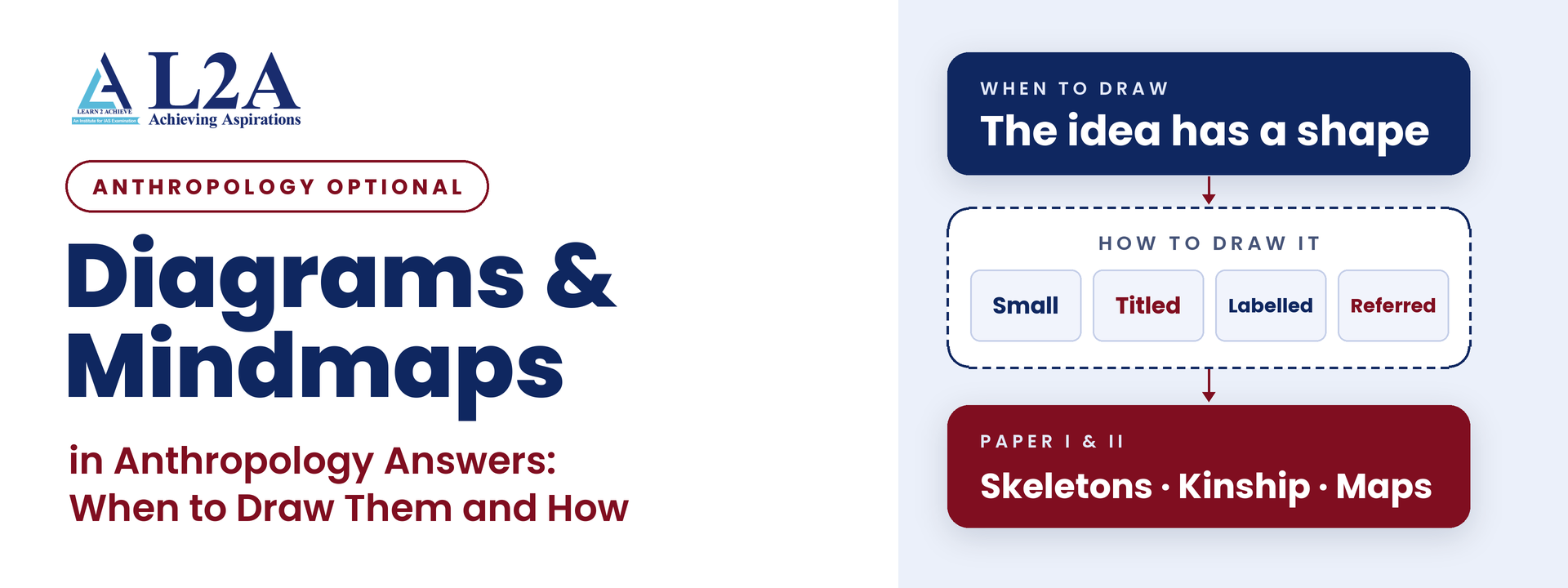
Short answer: use diagrams in Anthropology answers when the idea has a shape. A skeleton, a family tree, a timeline, a map or a process. Skip it when the idea is an argument. Keep it small, label every part, give it a title, and refer to it in your text. A neat 90-second sketch often says what would take 80 words to write.
We evaluate a lot of Anthropology test copies every season, and one thing shows up again and again. Students either draw nothing at all, or they draw something for every question because a senior told them "diagrams fetch marks". Neither works. This post is about the middle path: which topics need a diagram, which need a mindmap, which need neither, and how to draw fast enough that it doesn't eat your time.
Why a diagram earns marks in Anthropology
Anthropology is an odd optional. Half of it is a science (bones, genes, fossils, stone tools) and half of it is about people (kinship, religion, tribal policy). The science half is full of things that are easier to see than to describe.
Try explaining the change in the position of the foramen magnum in words alone. You'll need three sentences. Draw two skulls side by side, one ape and one human, with an arrow at the base, and the examiner gets it in a glance.
That's the real job of a diagram. It isn't decoration. It saves the examiner time, and it proves you understand the structure, not just the vocabulary. An examiner going through a large pile of copies notices an answer that is easy to read. A clean diagram is one of the quickest ways to be that answer.
When to draw, and when not to
Ask one question before you pick up the pen: does this idea have a shape?
Draw when:
- The question literally asks for it. "Illustrate", "with the help of a diagram", "draw a pedigree". Not drawing here is throwing marks away.
- You're describing anatomy or morphology. Skulls, pelvis, dentition, the bipedal skeleton.
- You're showing relationships between people. Kinship, descent, cross and parallel cousins.
- You're showing change over time. Hominin evolution, the sequence of Palaeolithic cultures, the shift in tribal policy.
- You're placing things in space. Prehistoric sites, tribal regions, Indus sites.
- You're explaining a process. Inheritance of a trait, a research design, how a development scheme reaches a village.
Don't draw when:
- The question asks you to critically examine a theory or discuss a debate. A box with "Functionalism" in the middle and four arrows adds nothing an examiner hasn't seen a hundred times.
- You're short on time and the answer isn't finished. Content first, always.
- The diagram would just repeat your paragraph in boxes. If it doesn't add anything, cut it.
A rough rule we give our students: in a 15 or 20 marker on a Paper I physical or archaeological topic, a diagram is close to expected. In a 10 marker on theory, it's optional at best.
Paper I: which diagram fits which topic
Paper I is where diagrams do most of the heavy lifting. This is the list we give our own students. You don't need all of it on day one. Start with the topics you're weakest in.
|
Topic |
Diagram that works |
What to label |
|---|---|---|
|
Human evolution |
Horizontal timeline of hominins |
Approximate dates (mya), key species, first tools, first exit from Africa |
|
Primate classification |
Branching flowchart |
Strepsirhini vs Haplorhini, then tarsiers, platyrrhines, catarrhines, hominoids |
|
Bipedalism |
Ape and human skeleton side by side |
Foramen magnum, S-shaped spine, bowl-shaped pelvis, valgus knee, arched foot |
|
Skull comparisons |
Two or three skull outlines |
Brow ridge, cranial capacity, prognathism, chin |
|
Mendelian genetics |
Punnett square, pedigree chart |
Genotypes, carriers, affected individuals, generation numbers |
|
Population genetics |
Hardy–Weinberg box |
p² + 2pq + q² = 1, and the conditions it assumes |
|
Chromosomal aberrations |
Simple karyotype sketch |
Which chromosome, what changed (trisomy, deletion, translocation) |
|
Kinship |
Kinship diagram |
Triangle for male, circle for female, = for marriage, Ego clearly marked |
|
Cross and parallel cousins |
Small kinship diagram |
Shade the cross cousins so the contrast is obvious |
|
Theories |
One-line flowchart |
Evolutionism → diffusionism → functionalism → structuralism, with one name under each |
|
Prehistoric tools |
Outline of a handaxe or Levallois core |
Flake scars, striking platform, cultural phase |
|
Dating and stratigraphy |
Layered section |
Older layers below, where the sample came from, the method used |
|
Somatotype |
Heath–Carter somatochart |
Endomorphy, mesomorphy, ectomorphy, where the subject falls |
|
Demography |
Population pyramid |
Age bands, male and female sides, the shape (expanding, stable, shrinking) |
|
Research methods |
Fieldwork flowchart |
Problem → rapport → observation and interviews → analysis → write-up |
One honest warning about the evolution timeline. Fossil dates keep shifting as new finds come in, and textbooks round them differently. Write "c." before a date and stick to ranges. Nobody loses marks for writing "c. 2 mya". You do lose the examiner's trust with a precise figure that's simply wrong.
Paper II: maps, flowcharts and mindmaps
Paper II is Indian Anthropology, and it reads more like social science. Fewer bones, more policy. So the diagrams change. Three types cover almost everything.
Outline maps of India
A rough map of India takes about a minute once you've practised it twenty times. It doesn't have to be accurate to the border. It has to be recognisable, with your points placed in roughly the right region.
Good uses:
- Andaman and Nicobar PVTGs. Mark the Great Andamanese, Onge, Jarawa and Sentinelese in the Andamans, and the Shompen on Great Nicobar. A question on island PVTGs almost asks for this.
- Prehistoric sites. Bhimbetka in Madhya Pradesh, Hunsgi and Isampur in Karnataka, Attirampakkam in Tamil Nadu, Hathnora on the Narmada. Put them on one map and your Palaeolithic answer looks organised before the examiner reads a word.
- Tribal belts. The central Indian belt, the North East, the southern hills, the islands. Useful for any question on distribution or regional variation.
Flowcharts for policy and change
Anything that moved in stages over time works as a flowchart. The classic one is tribal policy:
Isolation (colonial period) → Assimilation (the view that tribes are "backward Hindus") → Integration (Nehru's Panchsheel, written as a foreword to Elwin's book on NEFA)
Put one or two words under each stage. That's it. The paragraphs around it do the explaining.
Other flowcharts that work: the process of Sanskritisation, the stages of a tribal movement, how a scheme travels from ministry to Gram Sabha.
Mindmaps for issues with many sides
Questions on tribal health, land alienation, displacement or PVTG problems have many sides. A small mindmap with the issue in the centre and four to six branches (economic, health, education, land, identity, governance) shows the examiner you've seen the full picture.
The constitutional safeguards for Scheduled Tribes are a natural mindmap too. Centre node: "Safeguards for STs". Branches: Fifth and Sixth Schedules (Article 244), Article 275(1) grants, Article 342 (notification of STs), the National Commission for Scheduled Tribes (Article 338A), PESA 1996, and the Forest Rights Act 2006.
How to draw in the exam hall: practical rules
These are small things. Together they're the difference between a diagram that helps and one that looks like a doodle.
- Keep it small. A quarter of the page, at most. A 15 marker is still mostly writing.
- Budget your time. One to two minutes per diagram. If it's taking longer, you haven't practised it enough. That's a preparation problem, not an exam-day problem.
- Give it a title. "Fig. 1: Changes in the human skeleton linked to bipedalism". A title tells the examiner why the drawing is there.
- Label everything that matters. An unlabelled skull is just a circle. The labels carry the marks.
- Refer to it in your text. Write "as shown in Fig. 1" somewhere in the paragraph. It ties the drawing to the argument.
- Place it where it belongs. Usually right after the paragraph it supports, not at the end of the answer as an afterthought.
- Use a plain pen, or a pencil for the outline. Neat lines, no shading marathons. Read the instructions on the answer booklet itself for what is allowed, and follow them.
- Draw your standard set from memory. Around twenty diagrams cover most of the syllabus. Practise each one until you can draw it without looking.
That last rule is the big one. In the exam hall you won't be designing diagrams. You'll be reproducing ones you've already drawn many times.
Mindmaps: where they help and how to build one
Mindmaps get oversold on YouTube. Some students start drawing one for every answer, and the copy ends up looking busy without saying much.
Where mindmaps really help
- In the introduction of a 15 or 20 marker on a broad issue, to show the dimensions you're about to cover.
- In the conclusion, as a quick summary of the way forward.
- In your notes, as a revision tool. This is honestly where mindmaps shine. One page per topic, revised the week before the exam.
How to build one in the exam
- Write the core issue in the centre. Keep it short: "Land alienation among tribes".
- Draw four to six branches. No more. Each branch is one dimension: causes, legal angle, economic impact, cultural impact, government response, way forward.
- Put two or three words on each branch. Not sentences.
- Add one specific detail to at least two branches: a law, a committee, a case. This is what separates your mindmap from everyone else's.
For the land alienation example, a specific branch might read "Samatha judgment, 1997" or "PESA, Gram Sabha consent". General branches like "poverty" and "illiteracy" are fine, but they don't impress anyone on their own.
Mistakes that cost marks
We see the same handful of mistakes every time we evaluate test copies.
- Drawing instead of writing. A beautiful skeleton with three lines of text under it. The diagram supports the answer. It can't be the answer.
- No labels. Shapes with no names. The examiner can't give marks for something they have to guess.
- Wrong facts inside the drawing. A kinship chart where the cross cousin is marked as parallel. A timeline with Neanderthals before Homo erectus. A mistake inside a diagram is very visible.
- The same generic flowchart everywhere. "Causes → Effects → Solutions" in boxes, used for every Paper II question. Examiners spot it immediately.
- Running out of time. Spending four minutes on a map and leaving the last question half-done. No diagram is worth an unattempted question.
- Drawing because the topper did. You've seen a topper's copy with a diagram on every page. Their diagrams worked because each one fit its question. Copy the judgment, not the habit.
A four-week practice plan for Anthropology diagrams
Diagrams are a motor skill as much as a knowledge skill. Your hand has to know them. Here's a plan that fits around your regular study without taking it over. Give it about 20 minutes a day.
Week 1: the body
Bipedal skeleton, ape vs human skull, primate classification chart, hominin timeline. Draw each one five times across the week. Time yourself from the third attempt onwards.
Week 2: genes and people
Punnett square, pedigree chart, Hardy–Weinberg box, kinship diagram with cross and parallel cousins, somatochart, population pyramid. Check your kinship symbols against your notes every single time. Small errors here are common.
Week 3: India
One outline map of India every day, from memory. Add a different layer each day: island PVTGs on Monday, Palaeolithic sites on Tuesday, tribal belts on Wednesday, and so on. Then draw the tribal policy flowchart and the ST safeguards mindmap until you can do both in under two minutes.
Week 4: put them inside answers
This is the week most students skip, and it matters most. Write two previous-year questions a day with the diagram placed inside the answer, titled and referred to in the text. Then get those answers checked by someone who will tell you honestly whether the diagram helped or just took space.
FAQs on diagrams in Anthropology answers
Are diagrams compulsory in UPSC Anthropology answers?
No. They're compulsory only when the question asks for one, with words like "illustrate" or "with the help of a diagram". Otherwise, draw one when it explains something faster than words can.
How many diagrams should I draw in one Anthropology paper?
There's no fixed number. Paper I usually has more room for them because of physical anthropology and prehistory. Paper II needs fewer: a map, a flowchart or a small mindmap where the topic suits it. Let the question decide, not a target count.
Do diagrams get separate marks in UPSC Mains?
UPSC doesn't publish a marking scheme that gives diagrams separate marks. A good diagram helps because it shows understanding clearly and saves the examiner time. A bad one just costs you minutes.
Can I use colour pens or a pencil for diagrams?
Follow the instructions printed on your answer booklet, since those are the rules that apply on the day. A neat diagram in the same pen you're writing with is always safe. Colour isn't what earns marks. Labels are.
How long should one diagram take in the exam?
One to two minutes. If it takes longer, practise it more before the exam rather than skipping it on the day.
Are mindmaps okay in a 10 mark answer?
Usually they're too much for a 150-word answer. A small flowchart or a two-line labelled sketch fits better. Keep mindmaps for 15 and 20 markers on broad issues.
Which Anthropology diagrams should I learn first?
Start with five: the bipedal skeleton, the hominin timeline, a kinship diagram, an outline map of India with tribal regions, and the tribal policy flowchart. They show up across many questions.
Where to go from here
If you take one thing from this post, let it be this: a diagram earns marks only when it explains something faster than your words can. Draw it small, label it, give it a title and refer to it in your text. Do that consistently and your copy will stand out without any tricks.
The hardest part is knowing whether your diagrams are actually working. You can't judge that from your own copy. Someone else has to read it.
That's what the L2A Anthropology Test Series is built for. Every copy is evaluated by our faculty under Bala Sir's guidance, with comments on structure, content and diagrams, so you know what to keep and what to cut before the real exam.
More from L2A:
- The 5-part structure for Anthropology answers
- Anthropology Optional coaching at L2A
Questions about the test series or the course? Call us on 9821805141 or visit l2a.in.