

How L2A Evaluates a Sociology Answer Copy: The 5-Point Feedback Sheet Explained
You write a Sociology answer. You read it once and feel it's decent. You have the thinkers, the concepts, and a conclusion. Then the copy gets checked, the marks come back lower than expected, and you wonder what went wrong.
Almost every Sociology Optional aspirant has been here. Marks are not lost only because of missing content. They are often lost in small places you cannot see easily when you check your own work.
That is why it helps to understand how UPSC Mains answers are evaluated, and what a faculty member actually looks at when they check a Sociology answer copy.
In this blog, we explain the 5-point feedback sheet we use at L2A. We also walk through a sample answer, show why self-checking often misses problems, and explain how to turn feedback into real improvement.
Let's start with the basic question.
Why Evaluation Matters in UPSC Sociology Answer Writing
Most students put a lot of effort into reading. They finish the syllabus, make notes, and revise thinkers. That effort is important. But Mains is not a test of what you know. It is a test of what you can write in a limited time, in a clear and organised way.
Here is the problem many aspirants face:
- They write regularly but don't know if their answers are actually getting better.
- They check their own answers and miss small but important issues.
- They read model answers and assume they have learned how to write like that.
- They believe that if the content is right, the marks will follow.
But marks depend on two things: what you know and how well you present it. Evaluation helps you see the second part, which is the one students usually ignore.
Writing More Answers Is Not Enough
"Just write more answers" is the most common advice in answer writing. It is not wrong, but it is incomplete.
If you write fifty answers and repeat the same mistake in all fifty, you have not improved. You have only practised the mistake fifty times.
Real improvement follows a simple cycle:
Write → Get evaluated → Understand mistakes → Correct → Write again
Writing is only the first step. Without the steps after it, the practice does not turn into progress.
What Does a Faculty Member Look for in a Sociology Answer?
When a faculty member opens your answer copy, they are not only counting how many points you have written. They are asking a few simple questions. Can I follow this answer easily? Is the student actually answering what was asked? Does it start and end well?
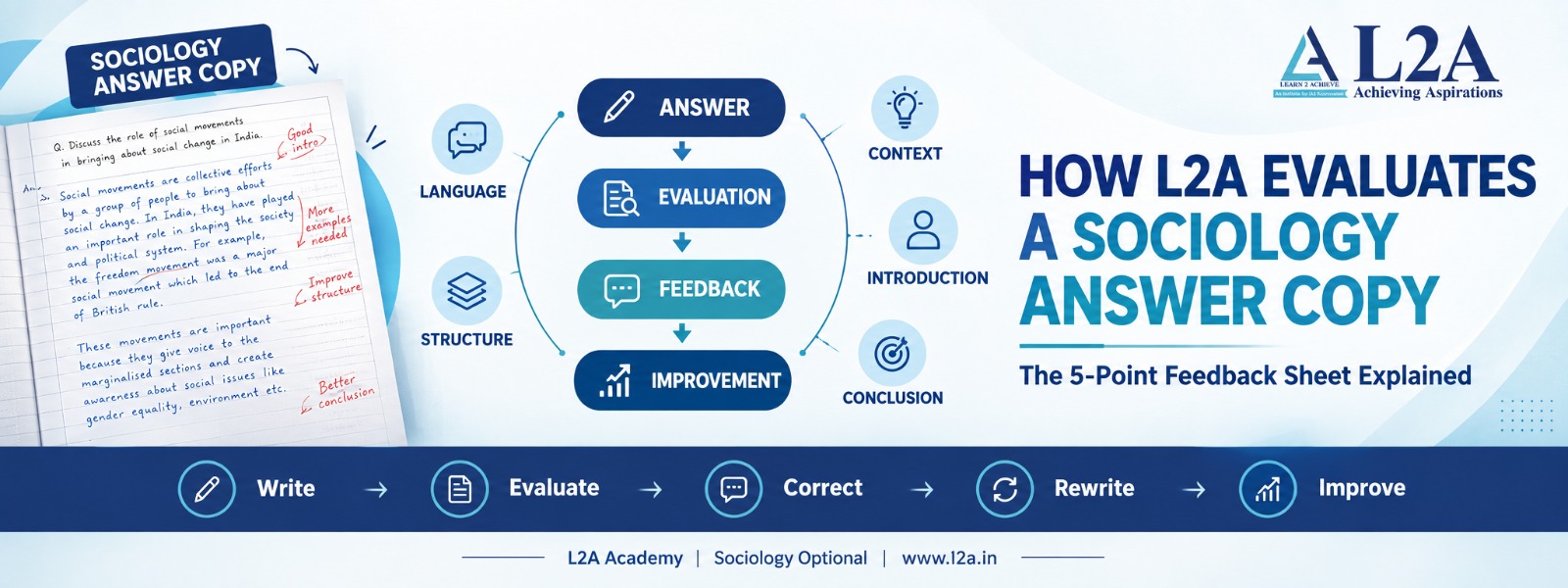
At L2A, we organise this into a 5-point feedback sheet. Here is the quick view:
|
Evaluation Point |
What Faculty Checks |
|---|---|
|
Language |
Clarity, precision and appropriate academic language |
|
Structure |
Logical flow, organisation and presentation |
|
Context |
Relevance to the question and sociological context |
|
Introduction |
Whether the answer starts directly and effectively |
|
Conclusion |
Whether the answer closes with a relevant, balanced point |
These five areas cover most of what separates an average answer from a good one. Let's look at each in detail.
The 5-Point L2A Feedback Sheet Explained
1. Language — Is Your Answer Clear and Precise?
Language in Sociology does not mean fancy words. It means clear communication. An examiner reads hundreds of copies, so the answer that is easy to understand has an advantage.
Faculty usually check these things:
- Simple and clear sentences. Can the point be understood in one reading?
- No unnecessary words. Long sentences with repeated ideas make the answer heavy.
- Correct sociological terms. Words like social stratification, latent function or sanskritisation should be used properly, not loosely.
- No vague statements. Lines like "society is changing a lot" don't say anything specific.
- Easy-to-follow arguments. Each sentence should lead naturally to the next.
Example
Weak sentence: "Caste is a big problem in India and it affects many things in society in many ways."
Improved sentence: "Caste continues to shape access to education, occupation and marriage in India, even as its rigid ritual hierarchy weakens."
The second sentence is not harder to read. It is just more precise, and it says something specific. That is what faculty look for.
2. Structure — Can the Examiner Follow Your Argument?
You can have excellent content and still lose marks if the answer is poorly organised. Structure is how you arrange what you know so that the reader can follow it without effort.
A well-structured Sociology answer usually moves like this:
- A short introduction that sets the direction
- A core argument or explanation
- Relevant thinkers and concepts
- Examples, especially Indian ones where suitable
- Some analysis or criticism
- A closing conclusion
Think about it from the examiner's side. If points jump around, if a thinker appears with no link to the argument, or if the answer is one long block of text, the examiner has to work to find your good points. Many will not make that effort.
Structure is also about presentation. Short paragraphs, clear breaks and a visible flow make an answer look confident and in control. A well-arranged answer often feels stronger than a crowded one with the same content.
3. Context — Are You Actually Answering the Question?
This is one of the most important parts of the feedback sheet, and one of the most common places where students lose marks.
There is a difference between knowing Sociology and using Sociology to answer the question asked.
Many students read a question, spot a keyword, and write everything they know about that topic. The answer may be accurate, but it is not what the question wanted. This is called a "dumping" answer, and examiners recognise it quickly.
Faculty check whether you have:
- Understood the directive word. "Discuss," "critically examine," "comment" and "evaluate" all ask for different things.
- Stayed relevant. Every paragraph should connect back to the question.
- Linked concepts to the question. Don't just name a theory. Show how it helps answer what was asked.
- Chosen suitable thinkers. A thinker should be there because he or she adds to the answer, not just to fill space.
- Used Indian examples where the question calls for them.
If your answer is good Sociology but doesn't answer the question, it will not score well. Context is about using what you know in the right direction.
4. Introduction — Does the Answer Start Well?
The first few lines set the tone of the whole answer. A good introduction tells the examiner that you have understood the question and know where you are going.
Faculty usually check:
- Is the introduction relevant to the question?
- Does it address the question directly?
- Does it set up the context for the answer?
- Is it too long?
- Does it give a clear direction for what follows?
Here is something many students don't realise: an introduction does not need to be complicated. You don't need a famous quote or a big statement. Often, two or three lines that define the key concept or frame the issue are enough.
A long introduction can also hurt you. In a limited time, every extra line you spend at the start is a line you cannot spend on the main answer.
5. Conclusion — Does the Answer End Properly?
Many students treat the conclusion as an afterthought. They rush it, or they skip it because time is almost over. But a good conclusion leaves the examiner with a final, positive impression.
Faculty check whether your conclusion:
- Links back to the question directly
- Gives a balanced closing thought
- Adds a sociological perspective, not just a general remark
- Avoids repeating what was already written
- Stays short and to the point
A conclusion is not a summary of everything you said. It is the final point that completes your argument. Even one strong, relevant closing line is better than a long, repetitive paragraph.
What a Faculty Evaluation Looks Like on an Actual Sociology Answer
Reading about the five points is useful. Seeing them applied is better. Let's take one sample question and walk through how it would be evaluated.
Question: "Discuss the relevance of Merton's concept of manifest and latent functions in understanding contemporary society."
Imagine a student has written an answer on this. Here is how a faculty member would go through it, step by step. (This is a hypothetical example to show the process.)
Step 1 — Language
What works: The student uses the terms "manifest function" and "latent function" correctly. The sentences are mostly clear.
What needs improvement: A few lines are vague, like "Merton's idea is very useful in today's world." The answer does not say how or why it is useful. Some sentences are also longer than needed.
Step 2 — Structure
What works: The answer has a clear beginning, middle and end. The explanation of the concept comes first, followed by applications.
What needs improvement: The examples are mixed into the explanation, which makes it hard to separate the concept from its use. Breaking the answer into short, focused paragraphs would help the reader.
Step 3 — Context
What works: The answer defines both functions and gives one example.
What needs improvement: The question asks about relevance in contemporary society. The answer spends most of its space explaining the theory and very little on how it applies today. Merton is explained well but not actually applied to the question. This is the biggest gap in the answer.
A stronger answer would use present-day examples, such as social media, education systems or welfare schemes, to show how hidden or unintended effects shape society today. It could also mention a limitation of the concept to add balance.
Step 4 — Introduction
What works: The introduction defines manifest and latent functions in simple words.
What needs improvement: It begins with general lines about "the functionalist perspective" before reaching the point. It could go straight to the concept and then link it to contemporary society in one line.
Step 5 — Conclusion
What works: The conclusion is short and attempts to link back to the question.
What needs improvement: It repeats the definition instead of adding a final thought. A better ending would say something like: the concept remains useful because it helps us look beyond the stated purpose of institutions, while acknowledging that it may not fully explain conflict or inequality.
Overall Feedback
Good feedback doesn't stop at marking. It shows the student what to do next:
- What is working: Concept clarity and correct use of terms.
- What needs correction: The answer explains the theory but doesn't apply it to contemporary society. The introduction can be more direct, and the conclusion needs to add value.
- What to do next: Rewrite the answer with two contemporary examples, a more direct introduction and a balanced closing line.
This is how an evaluation becomes useful. The student now knows exactly where the answer lost quality and what to fix.
Why Self-Evaluation Often Misses These Problems
Some students say, "I check my own answers, so I don't need anyone else." Self-checking is a good habit, and you should continue it. But it has limits.
Here are some common reasons self-evaluation falls short:
- "I know the topic, so my answer must be good." When you know the topic well, your brain fills in the gaps. You read what you meant, not what you wrote.
- Checking only if all points are present. Having every point is not the same as presenting them well.
- Comparing with model answers. A model answer shows you a finished product. It does not tell you what is wrong with yours.
- Ignoring presentation and structure. Most students judge content first and rarely notice flow.
- Not noticing irrelevant content. If you wrote it, it feels relevant to you.
- Not understanding why marks were lost. A low score without an explanation doesn't help you improve.
Here is the key idea:
You cannot improve a problem you cannot clearly identify.
An outside, trained eye can see what you cannot. That is the real value of evaluation.
What Good Feedback Should Tell a Sociology Aspirant
Not all feedback is useful. Comments like "Improve your answer" or "Needs more depth" sound reasonable, but they don't tell you what to do.
Good feedback should tell you:
- What you did well, so you can keep doing it
- What is missing from the answer
- Where the answer lost quality
- What needs to change
- How to improve the next answer
In short, feedback should be actionable, not just evaluative. It should not only judge your answer. It should guide you on what to do next.
If the feedback you receive does not give you a clear next step, it is not doing its job.
From Evaluation to Improvement — What Should You Do With Feedback?
Getting your copy back is not the end of the process. It is the beginning of the most important part. Here is a simple four-step way to use feedback well.
Step 1: Read the Feedback Carefully
Don't just look at the marks. Read every comment and understand the actual problem. Take your time with it.
Step 2: Identify the Recurring Mistake
After a few answers, patterns will show up. Is it mostly language? Structure? Context? Introduction? Conclusion? Most students have one or two areas that keep repeating. Once you find yours, you know where to focus.
Step 3: Rewrite or Improve
Apply the feedback to the same answer or to a new one. Rewriting is where learning happens. It turns advice into habit.
Step 4: Track Your Progress
Keep a simple record. Over several answers, check whether the same mistake is appearing less often. Small, repeated improvements add up.
The whole process looks like this:
WRITE → EVALUATE → IDENTIFY → CORRECT → REWRITE → IMPROVE
How Faculty Evaluation Helps Improve Sociology Optional Answers
Regular, detailed evaluation can help in many practical ways. Over time, students often find improvement in areas such as:
- Use of thinkers. You learn when a thinker adds value and when he or she doesn't.
- Sociological terminology. You use the right terms more naturally.
- Structure. Your answers become easier to follow.
- Examples. You pick more relevant and specific examples, including Indian ones.
- Introductions. They become shorter and more direct.
- Conclusions. They become more meaningful.
- Question interpretation. You get better at understanding what is really being asked.
- Confidence. When you know what examiners look for, writing feels less uncertain.
To be clear, no evaluation can promise a specific score. Improvement depends on how seriously you work on the feedback. What evaluation does give you is clarity, and clarity makes your practice far more effective.
Faculty Evaluation vs Self-Evaluation
Both have a role in your preparation. But they work differently. Here is a simple comparison:
|
Self-Evaluation |
Faculty Evaluation |
|---|---|
|
You know what you intended to write |
Faculty sees what is actually communicated |
|
May focus mainly on content |
Looks at content and presentation |
|
Difficult to spot repeated mistakes |
Patterns can be identified across answers |
|
Usually compared with a model answer |
Gives question-specific feedback |
|
Limited external perspective |
Brings an experienced academic view |
The best approach is to use both. Keep reviewing your own answers, but get them checked by faculty regularly so that your blind spots don't stay hidden.
How L2A's Sociology Answer Evaluation Works
At L2A, our approach is built around faculty-led evaluation, not just giving a score. A number at the top of the page tells you very little. What helps is knowing why the answer scored that way and what to change.
Every answer is looked at through the five areas we covered in this blog:
Language → Structure → Context → Introduction → Conclusion
The idea is to give you feedback that is clear, specific and usable, so that your next answer is better than the last one.
This evaluation is part of a larger learning flow:
PYQs → Answer Writing → Faculty Feedback → Improvement → Test Series
You begin by practising previous year questions to understand the demand of the exam. You write answers and receive faculty feedback. You then work on your recurring mistakes, and finally you test yourself in a timed series to see how well the improvement holds up under exam conditions.
Want your Sociology answers evaluated by faculty?
Explore the L2A Sociology Test Series: https://l2a.in/sociology-test-series?p=main
Who Should Get Their Sociology Answers Evaluated?
Evaluation is useful at every stage of preparation, but it helps different students in different ways.
Beginners
If you are just starting, evaluation helps you understand what a UPSC-level Sociology answer should actually look like. You can build good habits from the beginning instead of fixing bad ones later.
Students Already Writing Answers
If you are already practising, evaluation helps you find the mistakes you keep repeating without realising it.
Repeat Aspirants
If you have appeared before, evaluation helps you improve the quality and presentation of your answers. Often the content is already strong, and the gap lies in how it is communicated.
Students Preparing for Mains
If Mains is close, evaluation helps you move from casual practice to proper timed test writing, where speed, structure and clarity all matter together.
FAQs
1. How are UPSC Mains answers evaluated?
UPSC Mains answers are checked by examiners who look at how well you have understood the question, how relevant and accurate your content is, and how clearly you present your points. Structure, language, examples and a meaningful conclusion all play a part in the overall impression of the answer.
2. How is a Sociology Optional answer evaluated?
A Sociology Optional answer is judged on its content as well as its presentation. Examiners look for correct use of concepts and thinkers, relevance to the question, a logical flow, suitable examples and clear language. Simply writing everything you know on a topic is not enough.
3. What do teachers look for in a Sociology answer?
Teachers generally look for five things: clear language, a good structure, relevance to the question, a direct introduction and a meaningful conclusion. They also check whether you have used thinkers and examples in a way that supports your argument.
4. Why is faculty evaluation important for UPSC answer writing?
Faculty evaluation shows you what you cannot easily see yourself. It points out repeated mistakes, explains why an answer lost quality and tells you how to fix it. This makes your practice more focused and less random.
5. How can I improve my Sociology Optional answers?
Start by writing regularly and getting your answers evaluated. Then identify your most common mistake, whether in language, structure, context, introduction or conclusion, and work on it. Rewrite your answers using the feedback, and track whether the same issue still appears.
6. What are the common mistakes in Sociology answer writing?
Common mistakes include writing everything you know instead of answering the question, using vague language, having a long or unclear introduction, poor structure, using thinkers without linking them to the question, and ending with a repetitive conclusion.
7. Is self-evaluation enough for UPSC answer writing?
Self-evaluation is a useful habit, but on its own it is usually not enough. You tend to read your answer with the knowledge of what you meant to say, so it is hard to notice gaps. An outside evaluation gives you a fresh and honest view of how your answer actually reads.
8. How does a Sociology test series help in answer writing?
A test series gives you regular, timed practice. When it comes with faculty evaluation, you also get feedback on every answer. This helps you improve your speed, structure and clarity together, which is what you need on exam day.
9. What should a good Sociology introduction contain?
A good introduction is short and direct. It can define the key concept or set the context of the question in two or three lines and show the direction your answer will take. It doesn't need to be complicated or full of unnecessary background.
10. How should I improve my conclusion in Sociology answers?
Keep it concise and link it back to the question. Add a balanced closing thought or a sociological perspective instead of repeating your points. Even one strong, relevant line can make your conclusion effective.
Conclusion
Here is the main message of this blog:
Writing an answer tells you what you know. Evaluation tells you how well you are communicating it.
Knowing Sociology is the foundation. But in the exam hall, what counts is how clearly, relevantly and confidently you put that knowledge on paper. And you can only improve that if someone shows you where you stand today.
So don't just write answers. Follow the full cycle:
Write → Get Feedback → Correct → Rewrite → Improve
At L2A, our faculty-led evaluation is designed to support exactly this process, so that every answer you write teaches you something for the next one.
If you are ready to improve your Sociology answer writing with faculty evaluation, explore the L2A Sociology Mains Test Series: