

Is It Too Late to Start Sociology Optional for CSE 2027? A Month-by-Month Plan from September
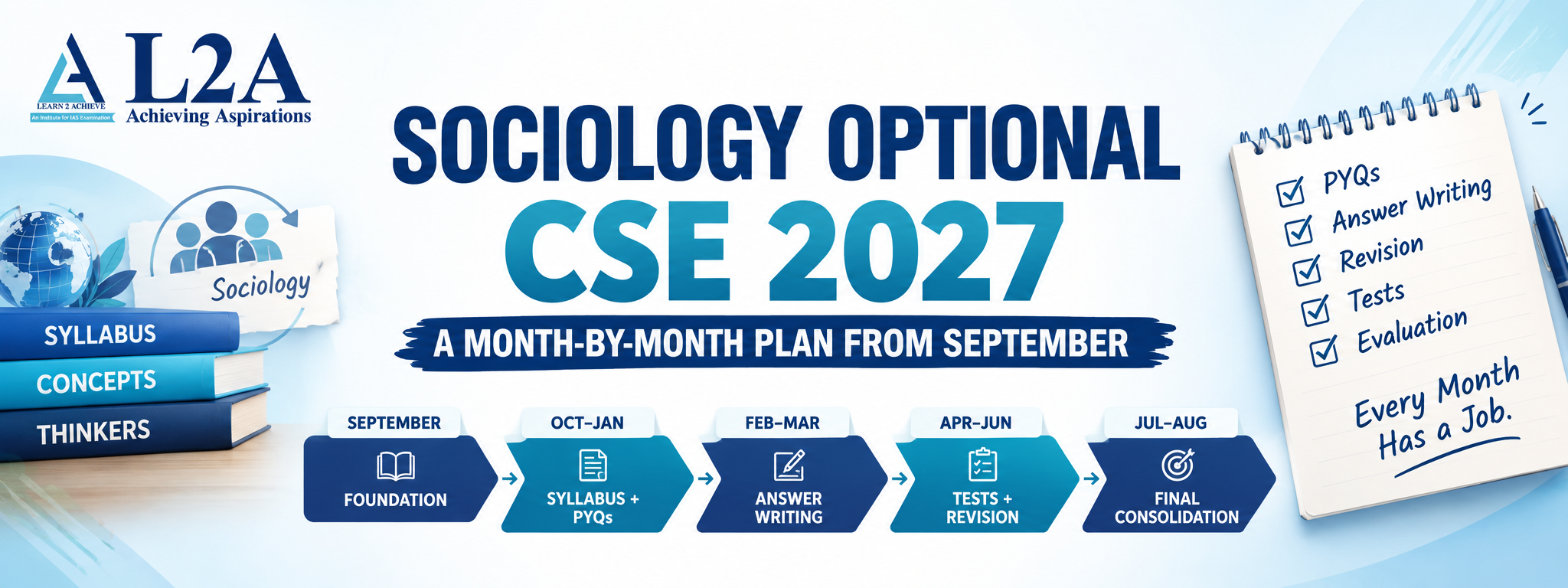
If you are starting Sociology Optional now, one question is probably sitting in your head: "Have I already wasted too much time?"
Let me answer that first. No, you have not. But September is also not the month to take things easy. You have enough time to prepare Sociology properly for CSE 2027, as long as every month has a job to do.
You need to follow one simple order: syllabus, concepts, thinkers, PYQs, answer writing, revision, tests. Students who start late usually don't fail because of time. They fail because they get stuck in the first step, reading and watching lectures forever, and never reach the last three.
In this blog, I will cover:
- how much time you really have
- a month-by-month plan from September to August
- how to split time between Paper I and Paper II
- when to start PYQs and answer writing
- how to handle thinkers and examples
- how to balance Sociology with GS
- a daily routine you can actually follow
I am not going to promise "complete Sociology in 30 days". That doesn't work. What works is a clear plan and steady effort.
Can You Still Start Sociology Optional in September for CSE 2027?
Yes, you can. The Sociology syllabus is compact compared to many other optionals. Paper I and Paper II together are very manageable if you stay disciplined. But you have to be honest about your time and plan around it.
First, Understand How Much Time You Actually Have
From September to the Mains exam, which usually falls around August, you have roughly 11 months. That sounds like a lot. It isn't, once you remember three things:
- Prelims comes in between, around May, and GS will demand your attention.
- You will lose days to illness, family work, and low-energy weeks.
- Revision and tests need at least 3 to 4 months of their own.
So the real time you have for learning fresh syllabus is about 4 to 5 months. The rest goes to PYQs, writing, revision, and tests. That is why the plan below is divided into phases, not just months.
Starting Late Is Not the Same as Starting Without a Plan
There is a big difference between being late and being unplanned. Here is how they look.
Unplanned preparation:
- Three or four books for the same topic
- Random lectures from different teachers
- PYQs left for "later"
- No answer writing until the syllabus is done
- Revision squeezed into the last month
Structured preparation:
- Full syllabus mapped on day one
- One or two sources per topic, not more
- PYQs studied along with each topic
- Short notes made as you go
- Answer writing starting early
- Revision and tests planned in advance
A student who starts in September with a structured plan is in a better place than one who started in June without one.
What You Should NOT Do
- Don't collect too many books. More books won't give you more marks.
- Don't spend months only watching lectures. Watching is not the same as being able to write.
- Don't push PYQs to the end. They tell you what UPSC actually wants.
- Don't wait for the syllabus to finish before you start writing answers.
- Don't treat Paper I and Paper II as two separate subjects. They talk to each other.
How Much Time Does Sociology Optional Actually Need?
Everyone asks "how many months?" A better question is "what should I be able to do by when?" Think of the preparation in five phases.
Foundation Phase
This is where you understand the syllabus, learn the basic concepts, and get comfortable with the major thinkers. You are not trying to be fast here. You are building the base that everything else sits on.
Coverage Phase
Now you finish both papers. Paper I first, then Paper II. The goal is a solid first reading of the full syllabus, with short notes made along the way.
Integration Phase
This is where PYQs, examples, and thinkers come together. You start asking, "How would I use this concept in an answer?" instead of just, "Do I understand this?"
Answer Writing Phase
You begin with short answers, move to 10-markers, then 20-markers, and then sectional tests. Writing is a skill. It only improves by writing.
Revision and Test Phase
Now you revise, take full-length papers, get them evaluated, and fix weak areas.
Don't measure your preparation only by how many months have passed. Measure it by what you can actually do with the syllabus. If you can take a PYQ and write a decent answer with a thinker and an example, you are on track.
Sociology Optional 2027 Month-by-Month Plan From September
This is the core of the blog. Read it once fully, then come back to it each month.
September: Understand the Syllabus and Build the Base
The main job this month is to see the whole picture. Read the complete Sociology syllabus slowly. Understand what Paper I covers and what Paper II covers. Start with the basic concepts of the subject. Begin the major thinkers, but only lightly. Look at a few PYQs just to see how UPSC asks questions.
Your target this month is not speed. It is a strong foundation.
By the end of September, you should have:
- the syllabus mapped topic by topic
- basic concepts started
- a simple framework for how you will study thinkers
- a first look at PYQs
October: Build Paper I Properly
Paper I is the base of the whole optional, so give it real time. This month focus on:
- Sociological thinkers
- Research methods
- Basic concepts
- Stratification and mobility
- Other major Paper I themes
Use this method for every topic: Read → Understand → Check PYQs → Make notes.
Don't leave PYQs for the end. If you check them right after finishing a topic, you learn what to focus on, and you stop reading things that never get asked.
November: Complete the Major Portion of Paper I
Now cover the rest of Paper I:
- Work and economic life
- Politics and society
- Religion
- Social change
- Application of thinkers
- Contemporary examples
This is also the month to start answer writing. Begin small, with 2 to 3 short answers a week. They won't be perfect, and that is fine. The point is to learn how to turn what you know into a Sociology answer.
December: Start Paper II Seriously
Paper II is where Sociology meets India. This month cover:
- Perspectives on Indian society
- Impact of colonial rule on Indian society
- Caste
- Class
- Tribal communities
- Rural and agrarian structure
Give special attention to Indian sociologists like G.S. Ghurye, M.N. Srinivas, A.R. Desai, and André Béteille. Make comparison-based notes. For example, how do Ghurye and Srinivas see caste differently? How does Desai's view differ from both? These comparisons make good answers.
January: Complete the Remaining Paper II
Finish the rest of Paper II:
- Social movements
- Population
- Industrialisation
- Urbanisation
- Religion and society in India
- Social transformation
- Contemporary Indian examples
By the end of January, your first reading of Paper I and Paper II should be mostly done. It doesn't have to be perfect. It has to be complete enough that you can start working with the whole syllabus.
February: PYQs and Answer Writing Come Together
From here, the way you study changes. Less of "what else should I read?" and more of "can I answer what UPSC asks?"
Work on:
- Topic-wise PYQs
- 10-mark and 20-mark answers
- Introductions and conclusions
- Thinkers and examples inside answers
- Diagrams where they help
- Comparisons
If you find yourself reaching for a new book this month, stop and pick a PYQ instead.
March: First Revision
Start your first serious revision cycle. Use this method: Topic → PYQ → Recall → Write → Check → Improve.
Build these while you revise:
- Short notes
- Thinker sheets
- An example bank
- Important diagrams
- A list of concepts you use often
April: Tests and Evaluation
This month is about testing yourself. Take:
- Sectional tests
- Paper I tests
- Paper II tests
- Timed answer writing
Then get your answers evaluated. This is the most useful part. Evaluation shows you whether your problem is a knowledge gap or an answer-writing gap. They need different fixes. If you don't know the topic, you study. If you know it but write badly, you practise.
May: Second Revision and Full-Length Practice
Focus on:
- Full-length papers
- Time management
- Second round of revision
- Weak topics
- Using thinkers better in answers
- Connecting Paper I and Paper II
Since Prelims usually falls around this time, adjust your Sociology hours realistically and keep a light daily revision going so you don't lose touch.
June: Consolidation
No new sources. Nothing fresh. The cycle is simple: Revise → Write → Evaluate → Improve. Confidence comes from repeating this again and again, not from reading one more book.
July: Final Revision Strategy
Now tighten everything. Work on:
- Short notes
- Thinkers
- Examples
- PYQs
- Key diagrams
- Introductions and conclusions
- Weak areas
August: Exam-Oriented Preparation
This is the last stretch. Your day is made of revision, tests, answer writing, and recall. Don't fall into new-book syndrome. Whatever you have now is enough. Trust it.
How to Divide Your Time Between Paper I and Paper II
Here is a simple way to split your effort.
|
Stage |
Paper I |
Paper II |
|
Foundation |
Higher focus |
Basic introduction |
|
Syllabus coverage |
50% |
50% |
|
PYQs |
Equal |
Equal |
|
Answer writing |
Equal |
Equal |
|
Revision |
Equal |
Equal |
|
Tests |
Equal |
Equal |
Don't treat them as separate. Paper I gives you the concepts. Paper II gives you the Indian application. When you write about caste in Paper II, the ideas of stratification, Weber, and Marx from Paper I make your answer stronger. And when you study a concept in Paper I, ask yourself where it shows up in India. That habit will help you a lot in the exam.
When Should You Start Sociology Optional Answer Writing?
Earlier than you think.
Don't Wait for Syllabus Completion
Many students say, "Let me finish the syllabus first, then I'll write." That is a trap. By the time the syllabus ends, you have no time left to build a writing habit. Start small and improve slowly. Even a weak answer written in November teaches you more than a perfect one you never wrote.
A Practical Progression
Follow this order:
- Short answers
- 10-markers
- 20-markers
- Sectional tests
- Full-length papers
Move to the next stage only when the current one feels comfortable. Don't rush to full-length papers in December.
How to Use PYQs From the Beginning
Most students treat PYQs as a revision tool. Use them as a learning tool instead. Here is how:
- Pick a topic from the syllabus.
- Find the PYQs related to that topic.
- Understand what the question is really asking. Is it asking you to explain, compare, or critically examine?
- Connect a thinker, a concept, and an example.
- Write the answer.
When you do this for every topic, you learn the syllabus the way UPSC wants you to know it.
How to Prepare Sociology Thinkers Without Memorising Them
Thinkers scare many beginners, and they end up memorising biographies. That doesn't help in the exam. Instead of Thinker → biography → theories, use this:
Thinker → Core idea → Argument → Example → Application → Criticism
Take Marx. The core idea is class and capitalism. The argument is that society is shaped by the conflict between those who own and those who work. An Indian example could be the conditions of gig workers or contract labour. The application is that you can use him in answers on inequality, labour, or social change. And the criticism is that he gives too much weight to economics.
Do this for each thinker on one page. When you can write that page from memory, you have really learned the thinker.
How to Build a Sociology Example Bank
Please don't build a giant current affairs notebook. You will never revise it. Keep it small and useful. For each entry, note down:
Issue → Sociological concept → Thinker → Indian example → 2-line analysis
For example, a news item about rising migration for work becomes an entry linked to social change, urbanisation, and a suitable thinker, with two lines on what it means. That is all. These short entries drop straight into your answers, and that is what makes an answer look fresh.
How to Balance Sociology Optional With GS Preparation
This is a big worry for September starters, so let's be practical.
Don't Study Optional in Isolation
Sociology and GS overlap in more places than you think. Society topics in GS1, social issues, and social justice all touch the same ground. Governance and social change examples can support your Sociology answers. And your daily current affairs reading gives you material for your example bank.
But be careful. Overlap does not mean GS preparation can replace Sociology preparation. GS will help with examples and general understanding. It will not teach you the thinkers, the perspectives, or how to write in the Sociology format. You still need dedicated Sociology time every day.
A Realistic Daily Routine for Sociology Optional
You don't need a 10 to 12 hour timetable, and most people can't follow one anyway. Here is a flexible structure. On a normal day the flow is:
Concept or lecture → Notes → PYQ → Revision → Answer writing
If you have 3 hours a day:
- 1 hour: new topic (reading or lecture)
- 30 minutes: notes and PYQs on that topic
- 30 minutes: revision of an older topic
- 1 hour: answer writing (a few days a week, and on other days use it for reading)
If you have 5 hours a day:
- 2 hours: new topic
- 1 hour: notes and PYQs
- 1 hour: revision
- 1 hour: answer writing and checking
Don't forget one thing. A smaller schedule that you follow every day beats a big one that you drop after a week.
Common Mistakes Students Starting Sociology in September Make
- Trying to finish too fast. Speed without understanding falls apart in the exam.
- Collecting too many sources. Pick one or two and stay with them.
- Ignoring Paper II. It is often more scoring, and it needs time.
- Memorising thinkers. Understand their ideas and use them.
- Delaying PYQs. They should start in the first month.
- Delaying answer writing. Start small, but start.
- Making huge notes. If you can't revise them, they are useless.
- Ignoring evaluation. Writing without feedback is only half the work.
- Studying by perceived weightage. Sociology can surprise you, so cover the full syllabus.
- Not revising completed topics. What you don't revise, you forget.
The September-to-Mains Sociology Preparation Formula
If you remember one thing from this blog, remember this line:
LEARN → CONNECT → APPLY → WRITE → EVALUATE → REVISE
- Learn: Understand the concept properly. Use one good source.
- Connect: Link it to a thinker, to the other paper, and to real life.
- Apply: Look at PYQs and see how the topic is asked.
- Write: Put it on paper in your own words, within the time limit.
- Evaluate: Get feedback. Find out where you lost marks and why.
- Revise: Come back to it again and again until it stays.
Every topic in the syllabus should go through this loop at least once, and most should go through it more than once.
How L2A Can Help You Prepare Sociology Optional
A plan like this is easier to follow when you have guidance. At L2A, the Sociology Optional preparation is built around the same ideas we talked about here: clear concepts, coverage of both Paper I and Paper II, using thinkers in answers, PYQ-based learning, regular answer writing, and proper evaluation. The Mains Test Series helps you check where you stand before the real exam.
If you are starting Sociology Optional in September and want a structured path instead of figuring everything out on your own, explore L2A's Sociology Optional programme and Mains Test Series.
(Add your L2A links here.)
FAQs
Is September too late to start Sociology Optional for CSE 2027?
No. You have around 11 months before Mains. That is enough to cover the syllabus, write answers, and revise, as long as you follow a structured plan and don't waste weeks on random reading.
Can I complete Sociology Optional in 5 to 6 months?
You can finish the first reading of both papers in about 4 to 5 months if you are consistent. But finishing the syllabus is not the same as being exam-ready. You will still need time for PYQs, writing, revision, and tests, so keep the rest of the year for that.
How many hours should I study Sociology Optional daily?
Around 3 to 5 hours a day is a good range, alongside GS. If you have less time, keep it steady. Regular study beats occasional long days.
When should I start answer writing for Sociology Optional?
By November, or even earlier if you feel ready. Start with short answers, then 10-markers, then 20-markers. Don't wait for the syllabus to end.
When should I start solving Sociology Optional PYQs?
From the first month. Look at PYQs right after you finish each topic. That way you always know what UPSC expects.
How should I divide Paper I and Paper II preparation?
Give them about equal time. Start with Paper I because it builds the base, then move to Paper II. Keep connecting the two while you study.
Can I prepare Sociology Optional alongside GS?
Yes. Many toppers do. The overlap in society and social issues helps, but keep fixed daily time for Sociology so it doesn't get pushed aside.
Is Sociology a good optional for beginners?
For many students, yes. The syllabus is short, the language is easy to follow, and the subject connects well with GS. It does need regular writing practice and clear thinking.
How should I revise Sociology Optional before UPSC Mains?
Use short notes, thinker sheets, your example bank, and PYQs. Do at least two full revision cycles and keep writing answers and getting them checked. Don't start new books in the last few months.
Can I start Sociology Optional without a background in Sociology?
Yes. Most students who take Sociology have no background in it. Start with the basic concepts, take your time with thinkers, and build up step by step.
Conclusion
Let's go back to the question you started with: "Am I too late?"
You are not. But starting in September doesn't mean you can rush blindly. It means every month now needs a purpose. You don't need more time. You need a better use of the time you have.
Here is the plan in one place:
- September: Foundation
- October to January: Coverage and PYQs
- February to March: PYQs and answer writing
- April to June: Tests and revision
- July to August: Final consolidation
Take it one month at a time, and keep writing. If you want guidance along the way, you can explore L2A's Sociology Optional programme and Mains Test Series.