

UPSC Mains Is Ending: Why You Should Start Sociology Optional Now
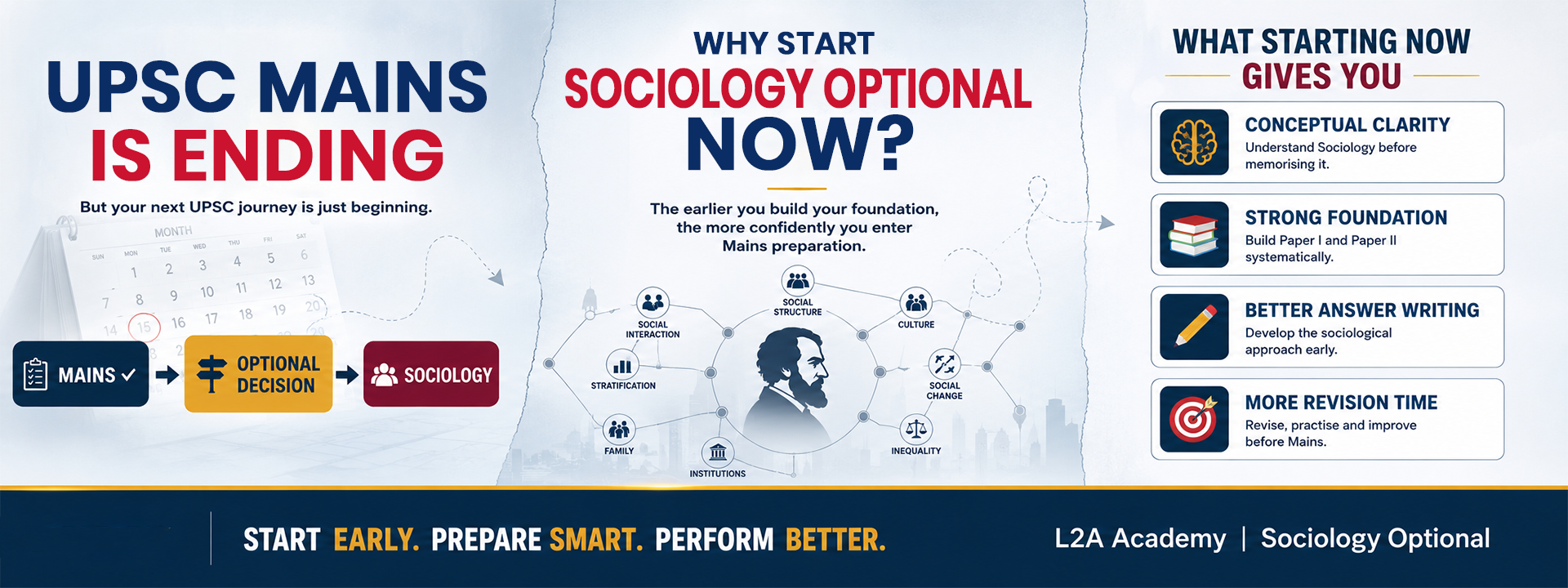
UPSC Mains is wrapping up. For the students who wrote it, there's a short breather ahead. But for everyone else, the ones who haven't attempted Mains yet or are getting ready for their first real shot, this is where the actual preparation begins.
This window right after Mains is oddly quiet on the internet. Everyone's attention is on the students who just finished the exam. But if you're starting fresh, this is exactly the time to sort out one of the biggest decisions in your UPSC journey, your optional subject. Finalise it too late, and you'll spend your last few months before Mains cramming a subject you barely understand instead of refining it.
Sociology is one of the subjects worth putting on your shortlist. Not because it's the easiest, and not because someone in your test series topped with it, but because it genuinely rewards early, steady preparation. This article walks you through why now is a good time to start, whether Sociology fits you, and exactly what to do in your first few weeks with it.
Why the End of UPSC Mains Is Actually a Good Time to Start Your Optional
There's a common pattern among aspirants: wait for the Mains result, wait for the notification, wait for Prelims to get over, and only then open the optional syllabus for the first time. It feels logical in the moment. In practice, it means your optional gets squeezed into the four or five months before Mains, alongside GS revision, essay practice, and test series. That's a rushed way to build a subject that needs conceptual depth.
Don't Wait for the UPSC Result to Start Preparing
Your optional choice doesn't depend on your Mains result. Whether you clear this attempt or not, you'll need an optional for the next cycle. Waiting for the result before deciding only delays something you could be working on right now.
Why Early Optional Preparation Reduces Mains Pressure
An optional built over ten to twelve months feels completely different from one built in four. When you start early, you get time to read slowly, make sense of thinkers instead of memorising them, and revisit topics more than once. That kind of repetition is what makes concepts stick, and it's very hard to manufacture in a rushed timeline.
What You Can Build Before Prelims
You don't need to finish the optional before Prelims. But you can realistically complete a first reading of the syllabus, build basic notes, and get comfortable with core concepts. That alone puts you far ahead of aspirants who open the optional book for the first time after Prelims.
Why Consider Sociology Optional for UPSC?
Sociology has a few practical advantages. The syllabus is relatively compact compared to many other optionals, which makes it manageable alongside GS. It's conceptual rather than fact-heavy, so it suits students who prefer understanding over rote learning. There's also a strong overlap with GS Paper 1's society section and with Essay, since topics like caste, gender, poverty, and social change show up in both places. And because it's a popular optional, study material, previous papers, and guidance are all easy to find.
That said, it's worth being honest about something most articles skip over: Sociology is not automatically easy or automatically high-scoring. It only looks that way from the outside. Scoring well means learning to think and write like a sociologist, not like a GS student. You still need to build a working vocabulary of concepts, understand thinkers well enough to apply them, connect theory to Indian examples, and practise answer writing consistently. Skip any of that, and the syllabus being short won't help you.
Who Should Choose Sociology Optional?
Sociology May Suit You If You:
- Enjoy trying to understand why society works the way it does
- Are comfortable engaging with analytical, idea-driven subjects
- Don't mind reading thinkers and their theories in some depth
- Want an optional that overlaps naturally with GS and Essay
- Can connect abstract concepts to real, contemporary examples
Think Twice If You:
- Prefer subjects you can prepare mostly through memorisation
- Find conceptual or theoretical material difficult to engage with
- Plan to write broad, GS-style answers instead of sociological ones
- Are picking it only because a friend or topper scored well with it
None of these are dealbreakers on their own, but if most of the second list sounds like you, it's worth spending a week with the syllabus and a basic textbook before committing.
Understand the Sociology Optional Syllabus Before You Start
Before opening any book, spend time simply reading through the official UPSC syllabus. It's short, but every line in it matters, and understanding its structure will save you from reading randomly later.
Sociology Paper 1 — Fundamentals of Sociology
This paper covers the discipline's building blocks: sociological thinkers, research methodology, basic concepts like status and role, social stratification, social institutions such as family and religion, work and economic life, politics and society, and the broader process of social change.
Sociology Paper 2 — Indian Society: Structure and Change
This paper applies those same ideas to India specifically, covering the Indian social structure, caste, tribal communities, class, family, rural and urban society, social movements, population, and processes of development and change.
Treat the official syllabus, not a coaching institute's rewritten version of it, as your reference point. Institute material is useful for explanation, but the syllabus itself is what the examiner is working from.
How to Start Sociology Optional From Scratch
If you're beginning with zero background, here's a sequence that works better than diving straight into a thick reference book.
Step 1 — Read the Syllabus Closely
Go through every heading and sub-heading before you touch a single book. You should be able to explain, in your own words, what each topic is roughly about.
Step 2 — Build Basic Sociological Understanding
Start with foundational ideas: what sociology studies, how it differs from common sense explanations of society, and the core vocabulary you'll keep running into, like norms, values, institutions, and social structure.
Step 3 — Understand the Thinkers, Don't Just Memorise Them
For each thinker, follow one simple chain: what they argued, the concept they're known for, the criticism their work attracted, and where you could apply their idea in a modern example. Names without this context are hard to recall in an exam and even harder to use meaningfully.
Step 4 — Connect Paper 1 With Paper 2
As you study a Paper 1 concept, immediately ask where it shows up in Paper 2. Social stratification, for instance, connects directly to caste and class in Indian society. Making this link early builds a more integrated understanding of the subject.
Step 5 — Bring in Previous Year Questions Early
Don't save PYQs for the end. Looking at how a concept has actually been asked, even in your first pass through a topic, tells you how deep you need to go and what kind of examples the examiner expects.
Step 6 — Start Answer Writing, Even If It Feels Early
Begin with short, simple questions on topics you've just studied. You're not aiming for exam-standard answers yet, just the habit of putting concepts into writing.
Sociology Optional Paper 1 Strategy
How to Prepare Sociological Thinkers
Use a consistent framework for every thinker: their key idea, the concept associated with it, the criticism it faced, and a contemporary application. Thinkers commonly covered include Marx, Durkheim, Weber, Parsons, Merton, Mead, Goffman, and Habermas. You don't need to turn this into an encyclopedia of every thinker who ever wrote about society, depth on the syllabus-relevant ones matters more than breadth.
How to Study Sociological Concepts
Concepts like status, role, social structure, and social system are the vocabulary of every answer you'll write. Learn each one with a clear definition, an example, and a sense of how it connects to other concepts nearby.
How to Approach Sociological Theories
Theories, functionalism, conflict theory, symbolic interactionism, are lenses for looking at society, not standalone facts to memorise. Practise applying each lens to a familiar social situation so you understand what each one actually highlights.
How to Build Sociological Answer Frameworks
A useful default structure is: define the concept, bring in a relevant thinker, add a contemporary or Indian example, and close with a balanced view or criticism. Reusing this structure across topics builds consistency in how you write.
Sociology Optional Paper 2 Strategy
This is where many students lose marks, not from lack of knowledge, but from writing Paper 2 answers that read like Paper 1 theory with no Indian grounding.
Connect Paper 2 With Indian Examples
Every Paper 2 topic needs a concrete Indian example. Abstract discussion of caste or urbanisation without reference to actual Indian data, events, or shifts reads as thin to an examiner.
Use Thinkers in Indian Society Answers
Bring in Indian sociologists where relevant. Caste, for example, is often discussed through Ghurye, M.N. Srinivas, Louis Dumont, or Andre Beteille. Tribal communities are often approached through Verrier Elwin or Ghurye. Using the right thinker in the right context signals depth.
Connect Static Sociology With Current Affairs
A reliable way to use current affairs is to follow this chain: start with the static concept, link it to a current issue, bring in the sociological perspective on that issue, add a concrete example, and close with brief analysis. This is far more useful than the vague advice to "read the newspaper daily."
Best Books and Resources for Sociology Optional
Resist the urge to collect every recommended book on the internet. A focused, limited set of resources, read more than once, beats a shelf of books read only once.
Foundation Resources
NCERT Sociology textbooks are a solid starting point for building basic understanding before moving to optional-specific material.
Paper 1 Resources
George Ritzer's work is widely used for sociological theory, along with Haralambos and Holborn, used selectively rather than cover to cover, plus well-structured notes for quick revision.
Paper 2 Resources
Standard references on Indian society, along with IGNOU material used selectively for specific topics, and the work of relevant Indian sociologists tied to each theme.
Current Affairs Sources
Keep this selective and syllabus-linked. Not every news story needs to become optional material, only the ones that connect clearly to a topic on your syllabus.
How to Use PYQs for Sociology Optional
Previous year questions are one of the most underused resources in optional preparation. A simple way to work with them is this chain: syllabus topic, then the PYQ on it, then the underlying theme being tested, then the relevant thinker, then a fitting example, then your answer framework.
Don't Solve PYQs Only at the End
Going through relevant PYQs while you're still studying a topic, not months later, shapes how you read and note that topic from the start.
Identify Repeated Themes
Certain themes, caste dynamics, gender, social movements, come up in different forms year after year. Spotting these patterns tells you where to invest extra preparation time.
Understand the Demand of the Question
Pay close attention to the verb in each question, explain, examine, discuss, critically analyse. Each one expects a different kind of answer, and misreading the demand is a common way marks are lost.
Turn PYQs Into Revision Material
Keep a running list of PYQs by topic. In your revision phase, this becomes a faster way to test recall than re-reading full notes.
When Should You Start Sociology Optional Answer Writing?
Earlier than most beginners assume, but not before you have basic concept clarity. Jumping straight into full-length, timed answers without understanding the material first usually produces answers that are long but hollow.
A more natural progression looks like this:
- Build concept clarity on the topic first
- Practise short, untimed answers on that topic
- Move to slightly longer untimed answers
- Introduce timed practice once you're comfortable
- Attempt sectional tests covering a few topics together
- Finally, move to full-length tests under exam conditions
This progression matters more than the calendar date you start on. Someone with three months of concept clarity behind them will write a stronger timed answer than someone who jumped to timed practice in week one.
How to Balance Sociology Optional With GS Preparation
Where Sociology Helps GS
Topics like Indian society, social issues, poverty, and population feed directly into GS Paper 1 and often into Essay as well. Time spent on Sociology isn't time taken away from GS, a fair amount of it overlaps.
Why GS Knowledge Alone Isn't Enough for Sociology Optional
The overlap can be misleading, though. A GS answer explains an issue broadly. A Sociology answer needs a concept, a thinker, a sociological perspective, and an example woven together. Relying only on GS-level understanding in the optional paper tends to produce answers that read as generic rather than sociological.
A Practical Sociology Optional Roadmap
Rather than a rigid month-by-month timetable, it helps to think in phases you move through at your own pace.
|
Phase |
Main Focus |
|
Phase 1 |
Syllabus overview and foundational reading |
|
Phase 2 |
Paper 1 — thinkers, concepts, theories |
|
Phase 3 |
Paper 2 — Indian society and its structure |
|
Phase 4 |
Integrating PYQs into your notes |
|
Phase 5 |
Building the answer-writing habit |
|
Phase 6 |
Sectional and full-length tests |
|
Phase 7 |
Structured revision |
Before Prelims
Focus on syllabus completion, a first round of notes, and laying the foundation for answer writing.
After Prelims
Shift towards revision, deeper PYQ work, and full-length answer writing under timed conditions.
This roadmap only works if you start now. Trying to compress all seven phases into the four months before Mains is exactly the trap the beginning of this article talked about.
Common Mistakes Students Make in Sociology Optional
- Choosing Sociology only because it has a reputation for being scoring
- Collecting too many books instead of mastering a few
- Skimming past the syllabus instead of studying it closely
- Memorising thinkers' names without understanding their arguments
- Writing generic GS-style answers instead of sociological ones
- Avoiding sociological terminology in answers
- Ignoring Indian examples while answering Paper 2 questions
- Delaying answer writing until the syllabus feels "complete"
- Not attempting PYQs during the study phase itself
- Noting down current affairs without linking them back to the syllabus
How L2A Academy Can Help You Start Sociology Optional
Everything covered above, the syllabus structure, the thinkers, the Paper 2 examples, the answer-writing progression, is manageable on your own, but it takes time to figure out through trial and error. Structured guidance mainly saves you that time: it tells you what to read first, how deep to go with each thinker, how to bring in Indian examples correctly, and where your answers are actually falling short.
L2A Academy's Sociology Optional course, led by Dr. Neha Tiwari, is built around this same starting-now approach: complete syllabus coverage, conceptual clarity for both papers, regular answer writing with evaluation, PYQ-based practice, and mentorship through the preparation cycle. If you're finalising Sociology as your optional, it's worth exploring as a way to build the subject properly from week one instead of piecing it together on your own.
Frequently Asked Questions
Is Sociology a good optional for UPSC?
It can be, for the right student. It has a manageable syllabus and strong overlap with GS and Essay, but it still demands conceptual understanding, thinker application, and consistent answer writing. It isn't automatically easier than any other optional.
When should I start Sociology Optional preparation?
As early as possible, ideally right after you decide on it, rather than waiting for a result or notification. Starting early gives you time for repeated reading and steady answer-writing practice.
Can I start Sociology Optional after UPSC Mains?
Yes. In fact, the period right after Mains is a good window to finalise your optional and begin building it before Prelims preparation takes over your schedule.
Can a beginner prepare Sociology Optional from scratch?
Yes, with no prior background. Start with the syllabus and basic concepts, build thinker understanding step by step, and bring in Paper 2 examples as you go. A structured sequence matters more than prior exposure to the subject.
How many months are enough for Sociology Optional?
There's no fixed number, but ten to twelve months of steady, unhurried preparation generally produces stronger results than four rushed months squeezed in alongside GS revision.
Which books are best for Sociology Optional?
A focused set works better than a long list: NCERT for the basics, George Ritzer and selective use of Haralambos and Holborn for Paper 1, and standard Indian society references along with selective IGNOU material for Paper 2.
Should I prepare Paper 1 or Paper 2 first?
Most students start with Paper 1, since its concepts and thinkers form the base that Paper 2 builds on. Studying them together, connecting each Paper 1 idea to its Paper 2 application, works even better once you have some foundation.
How important are thinkers in Sociology Optional?
Very. Thinkers give your answers analytical weight. The goal isn't to memorise names but to understand each thinker's argument well enough to apply it to a concept or example.
When should I start answer writing for Sociology Optional?
Earlier than most beginners expect, once you have basic concept clarity on a topic. Start with short, untimed answers and gradually build up to timed, full-length practice.
How should I use PYQs for Sociology Optional?
Use them throughout your preparation, not just at the end. Studying PYQs alongside each topic shows you how it's actually tested and helps you spot themes that repeat across years.
Does Sociology Optional overlap with GS?
Yes, particularly with GS Paper 1's society-related topics and with Essay. But GS-level understanding alone isn't enough for optional answers, which need concepts, thinkers, and sociological analysis woven in.
Is coaching necessary for Sociology Optional?
Not strictly necessary, but structured guidance can shorten the time it takes to figure out what to read, how to approach thinkers, and how to improve your answer writing through regular evaluation.
Conclusion
One Mains cycle ending is simply another aspirant's preparation cycle beginning. If Sociology is on your shortlist, this is the moment to move from considering it to actually building it, understand what the subject asks of you, decide with a clear head, lay the conceptual foundation, work through both papers, practise with PYQs, get your answers evaluated, and revise before the next Mains arrives.
Start now, and by the time Prelims is behind you, Sociology won't be an unfamiliar subject you're rushing to finish. It'll be one you've already spent months getting comfortable with, ready for structured practice and revision when it matters most.