

Sociology Optional Mains 2026 Paper Analysis: Topic-wise Breakdown and 2027 Strategy
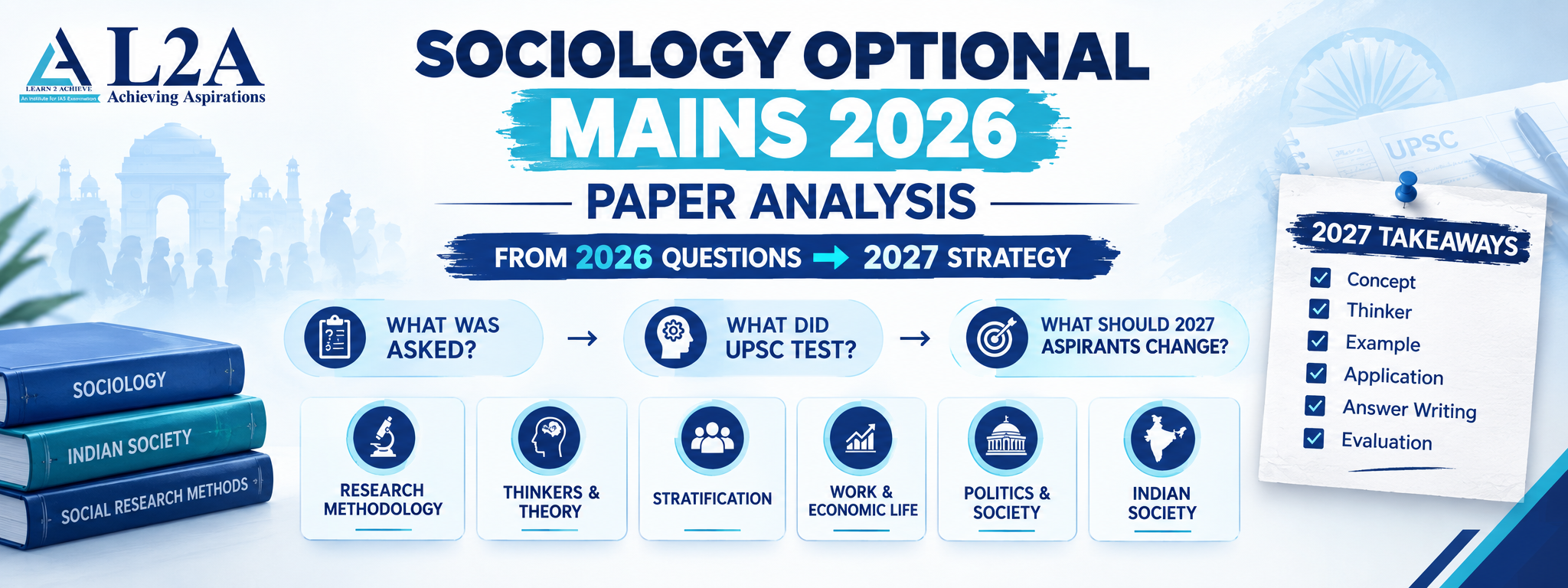
The Sociology Optional paper is over. For most students who wrote it on 30th August 2026, the first instinct is to go back and check — which questions did I attempt, which ones did I skip, and was this year kinder or harsher than the last one.
That checking is useful, but only for a few days. Once the paper is out of your hands, comparing your own attempt with the answer key stops being the most productive thing to do. What actually matters — for you if you're reattempting, and for anyone preparing for 2027 — is a different question: what was UPSC actually testing this year, and what would have made these questions easier to handle?
A 2027 aspirant reading this in October or November doesn't need to know whether Question 6(b) was a good pick over Question 7(a). They need to understand why UPSC framed the paper the way it did, and what kind of preparation would have made that framing feel less like a trap.
This article goes through the Sociology Optional 2026 paper topic by topic — both Paper I and Paper II — and turns that reading into an actual strategy for 2027. Not a list of predicted questions. A way of preparing that survives whatever specific questions show up next year.
Sociology Optional 2026 Paper at a Glance
Before getting into the analysis, here's the basic structure, for anyone who needs it as a reference point.
|
Particular |
Details |
|---|---|
|
Optional |
Sociology |
|
Paper I |
Fundamentals of Sociology |
|
Paper II |
Indian Society: Structure and Change |
|
Marks |
250 + 250 |
|
Total |
500 |
|
Duration |
3 hours each |
|
Exam date |
30 August 2026 (Paper I forenoon, Paper II afternoon) |
|
Question pattern |
8 questions per paper in two sections; Q1 and Q5 compulsory, with three more chosen, at least one from each section |
Sociology Optional 2026 Overall Analysis: What Did the Paper Really Test?
Read the 2026 paper end to end and a pattern starts to show up. It wasn't asking, in any of the sixteen questions across both papers, "have you read this chapter?" It was mostly asking, "can you do something with what you read?"
In Paper I, that showed up as a heavy pull toward research methodology — the part of the syllabus most aspirants treat as a formality to be finished early and never revisited. In Paper II, it showed up as questions that didn't just ask you to describe Indian society but to take a position on it — "according to you," "what would you recommend," "imagine Indian society without colonial rule." That's not recall. That's an argument, built on a foundation you're expected to already have.
Knowing sociology and using sociology in an answer are two different skills. The 2026 paper was built almost entirely around the second one.
This is the lens the rest of this article uses. For each major area, we'll look at what was asked, what that tells us about UPSC's intent, and what a 2027 aspirant should actually change in their preparation because of it.
Sociology Optional Paper 1 2026: Topic-wise Breakdown
Paper I is where the basic sociological machinery gets tested — theory, concepts, research methods, thinkers, and the major areas of social life. It's the paper students usually feel more confident about, because it maps neatly onto standard notes. 2026 didn't reward that confidence in a straightforward way.
Multiple topic-wise mappings of the 2026 paper point to research methodology, work and economic life, and politics and society as the areas that carried the most weight, alongside the usual questions on thinkers and stratification. Treat these mappings as informed analysis rather than an official UPSC classification — different coaching platforms group borderline questions slightly differently — but the broad direction is consistent across them.
Research Methodology
This is where the paper made its intentions clear. Questions built around positivism versus interpretivism, objectivity, grounded theory, and the difference between theory-driven and fact-driven research showed up across multiple parts of the paper, not tucked away in one corner.
One detailed breakdown puts methodology-linked areas at around 80 marks across six separate questions — which, if accurate, makes it the single biggest theme in Paper I, ahead of any individual thinker or institution.
2027 takeaway: Stop treating methodology as the unit you finish in week two and never open again. It rewards depth, not memorisation of definitions. Prepare it as a chain — concept, then the thinker associated with it, then the debate around it, then a real example, then the standard criticism. That chain is what turns a 10-mark bookish answer into a 20-mark analytical one.
Sociological Thinkers and Theory
Marx, Durkheim, Weber, Parsons, Merton, Mead, Goffman — the usual names appeared, and Marx's ideas on mode of production came up more than once. But the paper wasn't interested in what year Marx wrote something or which university Weber taught at.
The demand was almost always: use this thinker's framework to explain something. That's a subtle but important shift from biography to argument.
2027 takeaway: Your thinker notes should read like a toolkit, not a timeline. For each thinker, know what problem their idea solves and where you'd reach for it in an answer — not just what the idea says.
Social Stratification and Inequality
Caste, class, gender, intersectionality, informal economy, and the patriarchal bargain all found space in the paper. One question asked directly how class and caste intersect and overlap in shaping social structure — a straightforward-looking prompt that's actually hard to answer well without a genuine grasp of intersectionality as a concept, not just as a buzzword.
2027 takeaway: Every stratification topic needs four layers before you can call it exam-ready: the concept, the thinker attached to it, an Indian example, and a contemporary application. Skip any one layer and the answer reads thin.
Work and Economic Life
This chapter arrived in a noticeably modernised form. Questions on the informal economy and the position of women within it sat alongside contemporary framings — platform capitalism came up directly, pulling the discussion away from factory-era industrial capitalism and into gig work, app-based labour, and the blurred line between employment and self-employment.
2027 takeaway: Don't prepare "work" only from Haralambos-style textbook definitions. Know how the same old concepts — alienation, division of labour, informal work — map onto gig work, platform economies, and changing labour relations today. UPSC is clearly comfortable asking this connection directly now.
Politics and Society
Questions here tied together concepts like state, power, authority, citizenship, and nation with real political institutions rather than treating politics as an abstract chapter separate from the rest of the syllabus. This area, along with work and economic life, is being read by multiple analysts as carrying close to 60 marks each in the 2026 paper.
2027 takeaway: Politics and Society shouldn't live in isolation from Political Science-style content. Know how sociological concepts of power and authority differ from a purely political-science reading of the same terms — that distinction is often exactly what an examiner is testing for.
Religion and Society
Religion, secularisation, science, and new religious movements were tested through a fairly contemporary lens — less "define secularisation" and more "how is religious identity changing today, and why."
2027 takeaway: Build a small bank of recent, real examples of religious identity, practice, or organisation changing in India — you'll need it whether the question comes from this unit or gets stitched into a Paper II answer on communalism or secularism.
Social Change and Development
Theories of social change, migration, development, modernisation, and social movements appeared with an expectation that students connect theory with actual, observable transformation — not just list out Rogers' or Inkeles' models of modernisation from memory.
2027 takeaway: Whenever you learn a theory of change, immediately ask: where have I seen this play out in India in the last five years? If you can't answer that, the theory isn't exam-ready yet.
Sociology Optional Paper 2 2026: Topic-wise Breakdown
If Paper I tests whether you understand sociological ideas, Paper II tests whether you can use those ideas to actually read Indian society. And 2026 leaned into that test harder than usual — several questions asked candidates to take a personal position rather than simply describe a phenomenon.
Topic-wise mappings of Paper II converge on one clear point: perspectives on Indian society and the impact of colonial rule together accounted for the single largest block of marks in the paper — one detailed breakdown puts this opening block at around 130 of 400 printed marks. Population dynamics, social movements, and urbanisation also found real space, while caste as a standalone theme appeared with somewhat lighter weight than many students expected going in.
Perspectives on Indian Society
Ghurye, M.N. Srinivas, and A.R. Desai were all tested, including a direct comparison between two of them in one part-question — the kind of prompt that punishes students who've only ever written about these thinkers separately and never had to place them side by side. The structural-functional, Indological, and Marxist readings of Indian society all had a presence.
2027 takeaway: Prepare each perspective as: thinker, approach, main argument, a concrete example of it in use, and the standard criticism. Then go one step further and prepare short comparisons between pairs of thinkers — Ghurye vs Srinivas, Desai vs Béteille — because UPSC is clearly willing to ask for that directly.
Impact of Colonial Rule
This deserves special mention because of how much space it took up. One breakdown assigns roughly 70 marks to colonial-impact questions alone, and the framing wasn't purely descriptive — one question asked candidates to imagine what Indian society would look like without colonial rule, which is a counterfactual, analytical demand, not a recall one.
2027 takeaway: Stop preparing colonialism as a history chapter you're borrowing for Sociology. Prepare its sociological consequences — changes in social structure, institutions, reform movements, and nationalism — because that's the register UPSC is asking in, not the political-history register.
Caste and Social Stratification
Caste still appeared — including a question on the intersection of class and caste — but by most topic-wise mappings it carried noticeably less weight on its own in 2026 than perspectives or colonial impact did. That's worth sitting with for a moment, because caste is usually the chapter students over-invest in relative to everything else.
Never prepare a topic only according to last year's, or even last three years', weightage. Weightage moves. Understanding shouldn't have to move with it.
Rural and Agrarian Social Structure
Agrarian classes, land relations, and rural transformation were tested with a push toward connecting the static syllabus content to real, contemporary rural change rather than describing a village structure frozen in the 1950s.
Social Movements
Women's movements, agrarian movements, and newer forms of mobilisation all appeared, including some questions that pushed students to think about how movements have changed in form — moving from organised, on-ground mobilisation toward more dispersed and digitally mediated forms of protest.
Population Dynamics
Fertility, mortality, and demographic change were tested, and one question asked candidates to actually draw India's current population pyramid — a reminder that this section rewards students who can read and reproduce demographic data visually, not just discuss it in prose. This area is being estimated at around 40 marks in the 2026 paper.
2027 takeaway: Practise sketching a population pyramid and basic demographic diagrams by hand until it's automatic. A shaky, last-minute diagram under exam pressure costs more than most students expect.
Industrialisation and Urbanisation
Urbanisation, industrialisation, migration, and changing social relations in cities were tested with an expectation that students connect Paper I concepts of change and modernity to actual Indian urban examples — this is one of the clearest points of overlap between the two papers.
Tribal Communities, Religion and Social Transformation
Questions touching tribal communities, religion, secularism, and the broader challenges of social transformation also found space in the paper. The pattern across these questions wasn't breadth of coverage — it was specificity. General, textbook-level answers on these themes would have struggled against prompts asking for particular examples and particular arguments.
What Was the Biggest Difference Between Paper I and Paper II?
On the syllabus page, the two papers look like separate subjects. In preparation, and certainly in how the 2026 paper was framed, they shouldn't be treated that way.
|
Paper I |
Paper II |
|---|---|
|
Theory |
Indian application |
|
Thinkers |
Indian sociologists |
|
Concepts |
Social realities |
|
General sociology |
Indian society |
|
Theoretical examples |
Indian case studies |
|
Conceptual analysis |
Contextual analysis |
The honest way to read this table is: Paper I gives you the vocabulary, Paper II asks you to speak with it about India. A student who prepares them as two disconnected subjects is doing twice the work for half the benefit.
What Did UPSC Reward in Sociology Optional 2026?
Strip away the individual questions and five things stand out about what actually earned marks this year.
Conceptual Clarity
Not the ability to name a concept, but the ability to explain what problem it solves and where its limits are.
Thinker-Based Analysis
Answers that used a thinker's framework to build an argument scored differently from answers that simply mentioned the thinker's name in passing.
Application
The paper repeatedly rewarded students who could take a concept out of the textbook and place it against a real, current situation.
Specific Examples
Vague references to "changing Indian society" carried far less weight than a named, specific instance of change.
Ability to Connect Ideas
The strongest-looking answers, going by the framing of the questions, would have pulled together a concept, a thinker, and an Indian example in the same paragraph — not as three separate blocks.
Knowing Sociology and using Sociology are two different things. The 2026 paper was, more than most recent years, a test of the second one.
What Should a 2027 Aspirant Change After Seeing the 2026 Paper?
Stop Making Definition-Only Notes
A note that only has a definition is half a note. Add the thinker it connects to, a real example, and the standard criticism, right next to it — not in a separate file you'll never open again.
Start Mapping PYQs to the Syllabus
Build a simple chain for every question you go through: syllabus unit, then the PYQ, then the underlying theme, then the thinker it draws on, then a usable example. Do this consistently and the syllabus stops feeling abstract.
Build a Thinker Application Bank
Not a biography bank. For every major thinker, write down two or three situations where their framework is the right tool to reach for.
Build a Current Example Bank
Not a pile of newspaper summaries. A short, sociologically framed note on each contemporary issue — what concept it illustrates, and which thinker's lens explains it best.
Start Answer Writing Earlier
Don't wait until the syllabus is "complete" to start writing. Completion is a moving target; answer writing is what actually tells you whether you understand something or just recognise it.
Connect Paper I With Paper II
Make this a daily habit rather than a revision-time exercise. Every time you study a Paper I concept, ask where it shows up in Indian society. Every time you study a Paper II topic, ask which Paper I concept explains it.
A Practical Sociology Optional Strategy for 2027
Phase 1 — Build the Foundation
Go through the syllabus, the basic concepts, the thinkers, and the core readings without rushing. This phase decides how solid everything else will be.
Phase 2 — Complete Paper I and Paper II
Prioritise understanding over speed. A syllabus finished in a hurry, without the concept-thinker-example chain in place, will need to be redone later anyway.
Phase 3 — Integrate PYQs
Go topic-wise through past year questions, including 2026's, and practise identifying what each question is actually demanding — recall, application, or an argument.
Phase 4 — Build Answer Writing
Start small and build up: 10-markers first, then 20-markers, then sectional tests, then full-length tests under real time pressure.
Phase 5 — Revision and Evaluation
Follow a simple loop — write, get it evaluated, improve based on that feedback, and rewrite the same question a few weeks later. This loop, repeated, does more for your score than reading one more book.
Common Mistakes 2027 Aspirants Should Avoid
- Studying strictly according to one year's perceived weightage
- Memorising thinkers instead of learning how to use them
- Ignoring methodology because it feels dry or theoretical
- Writing generic, GS-style answers instead of sociologically grounded ones
- Collecting too many books instead of mastering fewer, well-chosen ones
- Postponing PYQ practice until "later"
- Postponing answer writing until the syllabus feels finished
- Treating Paper I and Paper II as two unrelated subjects
- Collecting current affairs without linking them back to the syllabus
- Writing examples without any sociological analysis attached to them
How L2A Can Help With Sociology Optional Preparation
Knowing what UPSC is asking is one thing. Building an actual preparation system around it, day after day, is a different problem — and it's the one most aspirants struggle with more.
L2A's Sociology Optional programme is built around the gaps this analysis keeps pointing to: conceptual clarity that goes beyond definitions, genuine Paper I and Paper II integration instead of two separate tracks, thinker application rather than thinker memorisation, PYQ-based preparation from day one, regular answer writing, and structured evaluation through a dedicated Mains Test Series.
If the 2026 paper analysis above made you rethink parts of your own preparation, that's a good sign — it means you're reading it the right way.
Explore L2A Sociology Optional → [link] and the L2A Mains Test Series → [link]
Frequently Asked Questions
How was the Sociology Optional 2026 paper?
Balanced, but not easy. The syllabus coverage wasn't unusual — most areas that appeared were familiar ones. What made the paper demanding was the number of questions that asked for application, comparison, or a personal position rather than straightforward description.
Which topics were most important in Sociology Optional 2026?
Research methodology and work/economic life stood out in Paper I; perspectives on Indian society and the impact of colonial rule stood out in Paper II. But treat this as a description of one year's paper, not a prediction for the next one.
What was asked in Sociology Optional Paper 1 in 2026?
A methodology-heavy mix — positivism versus interpretivism, objectivity, and research design — alongside questions on classical thinkers, stratification, work and economic life (including platform capitalism), politics and society, religion, and social change.
What was asked in Sociology Optional Paper 2 in 2026?
A strong focus on perspectives on Indian society and colonial impact, along with questions on caste-class intersection, agrarian structure, social movements, population dynamics (including a population pyramid), and urbanisation.
Was Sociology Optional 2026 difficult?
Not because the syllabus was unfamiliar — because the questions demanded application and argument rather than recall. Difficulty in this paper came from what you had to do with what you knew, not from what you had to know.
What does the 2026 Sociology paper mean for 2027?
That preparation built only around finishing the syllabus won't be enough. 2027 aspirants need to prepare each topic with a concept, a thinker, an example, and an application layered together from the start.
How important are PYQs for Sociology Optional?
Very. PYQs, including this year's, show you the register UPSC is asking questions in — not just the topics. Mapping them to the syllabus is one of the most useful habits you can build.
When should I start answer writing for Sociology Optional?
Earlier than feels comfortable. Don't wait for the syllabus to be fully complete — start with short answers on whatever you've already studied and build up from there.
How should I prepare Paper I and Paper II together?
Treat every Paper I concept as something you'll need to locate in Indian society, and every Paper II topic as something a Paper I concept can explain. Practise moving between the two papers daily, not just during revision.
Should I change my Sociology Optional strategy after the 2026 paper?
Refine it, don't panic over it. The core approach — concept, thinker, example, application, answer writing — hasn't changed. What 2026 shows is how strictly that approach was tested this time.
Conclusion — What Does the 2026 Paper Really Teach Us?
The biggest lesson from Sociology Optional 2026 isn't that UPSC has suddenly become unpredictable. It's that preparation can no longer stop at knowing the syllabus.
Understand the concept. Connect it to a thinker. Apply it to a real example. Write it under time pressure. Get it evaluated. Revise it. That loop, repeated enough times, is what the 2026 paper was quietly asking for.
A 2027 aspirant doesn't need to predict what next year's paper will ask. The more useful goal is to be ready for the different ways the same syllabus can be asked — because that's exactly what this year's paper did.
If you want that kind of structured, PYQ-driven preparation instead of building it alone from scratch, L2A's Sociology Optional course and Mains Test Series are built for exactly this.