

Anthropology Answer Writing Program 2027: What It Should Do and How to Use It
By the Anthropology faculty team at L2A, Old Rajendra Nagar, New Delhi
Short answer: An Anthropology answer writing program is a guided routine of writing answers to UPSC-style questions, getting them checked by someone who knows the optional, and rewriting them until the structure becomes automatic. A good one gives you regular questions, honest evaluation, model answers and a plan that runs from your first answer to the exam hall. For CSE 2027, the right time to start is now, while you're still studying the syllabus, not after you finish it.
Most Anthropology aspirants don't lose marks because they don't know the topic. They lose marks because they know it and can't put it on paper in seven minutes. We see this every season when we evaluate test copies: the content is in there somewhere, buried under a long introduction, with no example, no thinker and no conclusion. This post explains how answer writing for Anthropology actually works, what any answer writing program or course should give you, and a 10-month plan you can follow for 2027, with or without coaching.
Why Anthropology needs its own answer writing practice
You might already practise answer writing for GS. That helps, but it doesn't transfer fully. Anthropology answers are marked on things a GS answer rarely needs:
- Ethnographic evidence. "Tribes face land alienation" is a GS sentence. "The Dongria Kondh of Niyamgiri used Gram Sabha consent to stop bauxite mining" is an Anthropology sentence.
- Thinkers and concepts used correctly. Malinowski, Radcliffe-Brown, Lévi-Strauss, Srinivas, Dumont, Elwin and his critics, K. S. Singh. Not name-dropping, but placing them where they belong in the argument.
- Diagrams that carry content. A kinship chart, a bipedal skeleton or an outline map of tribal India can say in 90 seconds what takes 80 words. (We wrote a full guide on diagrams and mindmaps in Anthropology answers.)
- Links between Paper I and Paper II. A Paper II question on tribal policy reads better with a Paper I idea behind it, such as acculturation or the integration debate.
These are habits. You don't build them by reading. You build them by writing, getting feedback, and writing again.
The exam you're writing for
Before you plan practice, be clear about the format. Each Anthropology paper carries 250 marks and runs for three hours. There are eight questions in two sections. You attempt five: Questions 1 and 5 are compulsory, and you pick three more, with at least one from each section.
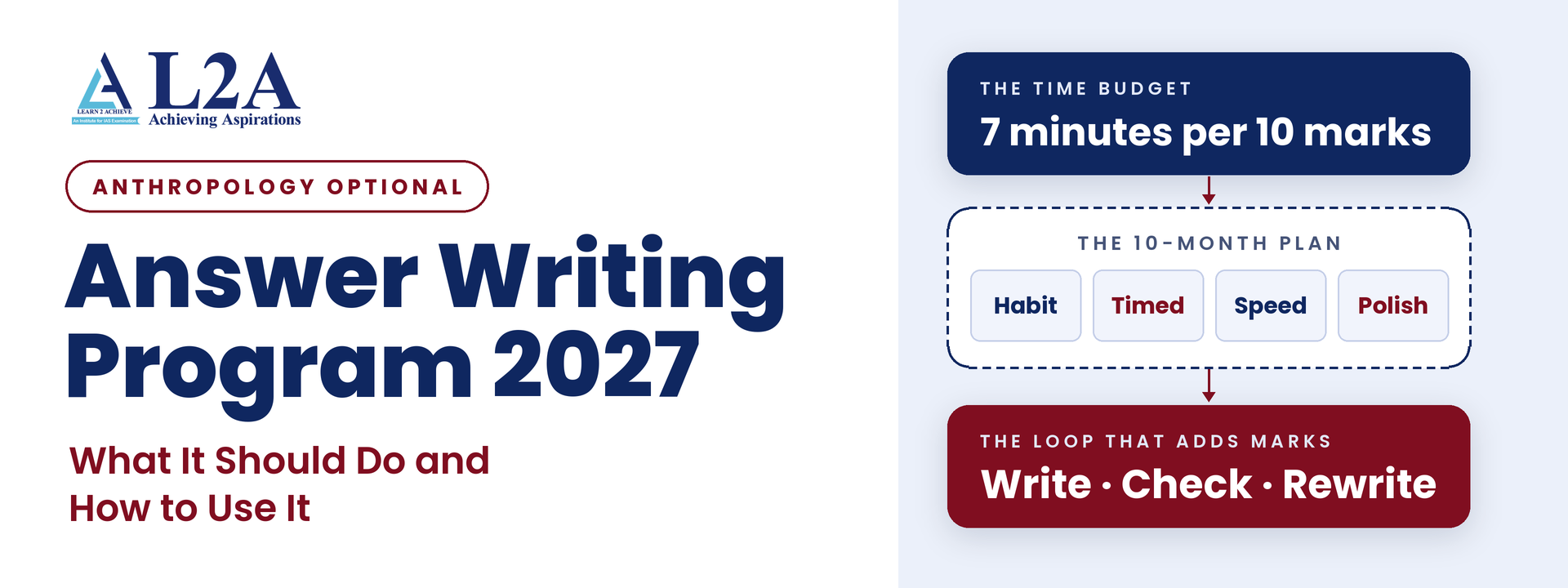
That gives you a simple time budget: 250 marks in 180 minutes is roughly 7 minutes for every 10 marks.
|
Answer type |
Typical length |
Time you can afford |
|
10 marker (most parts of Q1 and Q5) |
about 150 words |
about 7 minutes |
|
15 marker |
about 250 words |
about 11 minutes |
|
20 marker |
about 300 words |
about 14 minutes |
Check the word limit printed with each question on the day. Where none is given, these lengths are a sensible guide.
Here's the uncomfortable part. Twenty answers, back to back, in three hours, with no time to think about structure. If structure isn't already automatic by exam day, it won't appear in the exam hall. That's the whole case for a planned answer writing program.
What a good Anthropology answer looks like
We teach a 5-part structure for Anthropology answers, and it holds for most questions. Here it is applied to a real question, so you can see the parts working.
UPSC CSE 2026, Anthropology Paper II, Q7(b), 15 marks: "Does caste as a social category exist among the non-Hindu communities in India? Illustrate your answer with suitable examples."
- Introduction (2–3 lines): define caste as a hereditary, endogamous, ranked group. Then set up the debate: Louis Dumont tied caste to Hindu ideas of purity, while Imtiaz Ahmad's work on Muslim communities showed caste-like groups outside Hinduism.
- Body, the argument: take it community by community. Among Muslims, the Ashraf, Ajlaf and Arzal strata. Among Sikhs, groups such as Jat, Mazhabi and Ravidasia Sikhs. Among Christians, Dalit converts and separate worship spaces reported in parts of South India. Among Buddhists, the conversion of Mahars under Ambedkar.
- Body, the counterpoint: the doctrines of these religions are egalitarian, and the ritual side of caste is often weaker. What survives is mostly endogamy, status and occupation.
- Evidence that lifts the answer: the Constitution (Scheduled Castes) Order, 1950 first recognised only Hindus, then extended to Sikhs (1956) and Buddhists (1990). Dalit Christians and Dalit Muslims are still outside it, and a commission set up in 2022 is examining the question. That's caste visible in law, not just in practice.
- Conclusion (2 lines): caste exists among non-Hindus as social practice even where religious doctrine rejects it. Say so directly. "Illustrate" questions reward a clear verdict.
A diagram fits naturally here: a small three-tier box for Ashraf, Ajlaf and Arzal, or a timeline of the SC Order. Ninety seconds, and the examiner sees the structure before reading a word.
Now look at what most first-draft answers do with this question. A long definition of caste, two lines on "caste exists in all religions", no community-specific evidence, no legal angle, no conclusion. Same knowledge, half the marks. The gap between those two answers is exactly what an answer writing program exists to close.
What any Anthropology answer writing program or course should give you
Whether you join a program at L2A, somewhere else, or build your own routine, check it against this list.
- Questions on a fixed rhythm. Writing "when I feel ready" means writing in July. You need questions every week, tied to what you're studying that week.
- Evaluation by someone who knows Anthropology. Not a generic evaluator, and not a peer group. Ask who checks the copies and how much Anthropology they teach.
- Specific feedback. "Good attempt, improve structure" teaches nothing. Useful feedback names the missing ethnography, the misplaced thinker, the diagram that would have helped, and the 40 words you could cut.
- Model answers. Not to copy. To compare: what did a strong answer include that yours didn't?
- PYQ coverage. UPSC repeats themes far more than it repeats questions. Working through the last five years of papers, theme by theme, shows you what the examiner keeps coming back to.
- Full-length practice. Writing one answer in seven minutes is different from writing twenty in three hours. You need both sectional and full-length tests before Mains.
- A rewrite loop. The marks you gain come from rewriting a weak answer after feedback, not from writing the next one. A good program builds that step in.
- A plan that survives Prelims. Your answer writing will pause around Prelims. The program should know that and pick up after it.
A 10-month answer writing plan for CSE 2027
This is the plan we'd give a student starting in December 2026. Adjust the months if you start later. Don't skip a phase.
Phase 1: December to February, build the habit
- Write 3–4 answers a week on whatever you studied that week. Mostly 10 markers.
- Untimed is fine at first. Get the structure right, then the speed.
- Draw your basic diagrams from memory: the bipedal skeleton, the hominin timeline, a kinship chart, an outline map of India.
- Get at least one answer a week checked by someone else.
Phase 2: March to May, add time and sectional tests
- Time every answer. Seven minutes for a 10 marker, eleven for a 15 marker.
- Start sectional tests on completed units.
- Write previous-year questions by theme: human evolution, kinship, tribal policy, PVTGs, tribal movements.
- Slow down for Prelims. One or two answers a week keep the habit alive.
Phase 3: after Prelims, full speed
- Switch to full-length tests under exam conditions: three hours, five questions, one sitting.
- Rewrite your weakest answer from every test after reading the feedback.
- Do the last five years of Paper I and Paper II PYQs as full papers, not just single questions.
Phase 4: the final weeks, polish
- Fewer new answers, more rewrites.
- Revise your examples bank: one page of ethnographies, one page of thinkers, one page of laws, schemes and committees.
- Sit at least two full mock papers per paper, in the same time slot as the real exam.
Where L2A's Anthropology Achievement Program (AAP) 3.0 fits
Our own answer writing program for CSE 2027 is the Anthropology Achievement Program (AAP) 3.0. It's a 10-month mentorship program with Bala Sir, built around the plan above, and aimed at 300+ marks in the optional.
What the program page lists:
- Starts: 7 December 2026
- Duration: 10 months
- Mode: online or offline (Delhi)
- DAW sessions from Monday to Thursday
- Weekly tests (10+6) every Saturday
- PYQ analysis: recorded video analysis of the last five years of papers (2022–2026), released after the sectional tests
- Individual attention with personalised guidance
- Study material covering the entire syllabus
- Fee: ₹17,000 + 18% GST
On evaluation, the same standard applies across our Anthropology programs: copies are evaluated by experienced Anthropology faculty under the guidance of Bala Sir. Feedback covers content, structure, diagrams, use of ethnographic examples and time management, and each test comes with model answers. Online students write, upload their answers, and get the same evaluation as classroom students in Delhi.
Answer writing program, test series or PYQ evaluation: which one do you need?
They overlap, but they're not the same thing. Pick by where you are in your preparation.
|
Option at L2A |
What it is |
Best for |
Starts |
Fee (+ 18% GST) |
|
AAP 3.0 |
10-month mentorship and answer writing program with Bala Sir |
Starting answer writing early and keeping it up all year |
7 Dec 2026 |
₹17,000 |
|
Anthropology Test Series |
Sectional and full-length tests with evaluation and model answers (plans: 4+2, 6+2, 8+2, 10+4, 16+2 half-length) |
Students who've covered most of the syllabus and need exam practice |
5 Dec 2026 |
₹6,000 to ₹14,999 |
|
PYQ Evaluation |
Previous-year questions, written and evaluated |
Getting used to UPSC's own questions |
7 Dec 2026 |
₹3,000 (1 month), ₹12,000 (5 months) |
|
Mini PYQ Analysis Program |
Analysis of the 2022–2026 papers |
Understanding what UPSC keeps asking |
7 Dec 2026 |
₹5,000 |
A rough guide:
- Still studying the syllabus? An answer writing program, so practice starts alongside your reading.
- Covered 60–70% of the syllabus? A test series is the natural next step.
- Short on time, or want a low-cost start? PYQ evaluation for a month tells you quickly where you stand.
Full details and the plan comparison are on the Anthropology Test Series page.
Mistakes we see most often in Anthropology answers
- GS-style answers. General points about tribes and development with no ethnography and no thinker. Anthropology examiners expect anthropology.
- Thinkers in the wrong place. Radcliffe-Brown cited in an answer about change, or Elwin quoted without his critics.
- No example from India. Even in Paper I, an Indian case study makes a theory answer stronger.
- Long introductions. Six lines of definition in a 10 marker leaves no room for the argument.
- No conclusion, or a vague one. "Thus, it can be said that both have merits" earns nothing. Take a position.
- Unfinished papers. One unattempted question costs more than any amount of polish on the other four. Practise the full three hours.
FAQs on Anthropology answer writing
When should I start answer writing for Anthropology optional?
Start while you're still studying. Write short answers on each topic as you finish it. Waiting until the syllabus is complete leaves too little time to build speed and structure before Mains 2027.
How many answers should I write per week?
Three or four a week in the early months is enough to build the habit. Increase it after Prelims, when full-length tests take over. Regularity matters more than volume.
Do I need an answer writing program if I'm joining a test series?
Not necessarily. A test series gives you tests, evaluation and model answers once you've covered most of the syllabus. An answer writing program starts earlier and adds regular practice and mentorship across the year. Many students do the program first and the test series closer to Mains.
Can I do the Anthropology answer writing program online?
Yes. AAP 3.0 runs online and offline. Online students write and upload their answers and get the same faculty evaluation as students in Delhi.
Who evaluates the copies at L2A?
Experienced Anthropology faculty, under the guidance of Bala Sir. Copies aren't sent to outside evaluators.
Is self-evaluation enough?
It helps for checking structure and word count. It can't tell you what the examiner will notice is missing, because you can't see the gaps in your own answer. Get at least some of your answers checked by someone who teaches the optional.
How long should a 15 mark Anthropology answer be?
About 250 words, written in around 11 minutes, unless the question paper states a different word limit. Spend those words on evidence and argument, not on a long introduction.
Where to go from here
If you take one thing from this post, let it be this: answer writing is a skill you train, not a topic you study. Write regularly, get honest feedback, rewrite your weak answers, and by Mains 2027 the structure will come without you thinking about it.
If you want a structured way to do that with Bala Sir's guidance, AAP 3.0 starts on 7 December 2026. Questions about which program suits you? Call us on 9821805141 or 9871452328, or visit l2a.in.
More from L2A: