

Sociology Optional 2026 Analysis: 7 Lessons Every 2027 Aspirant Must Know
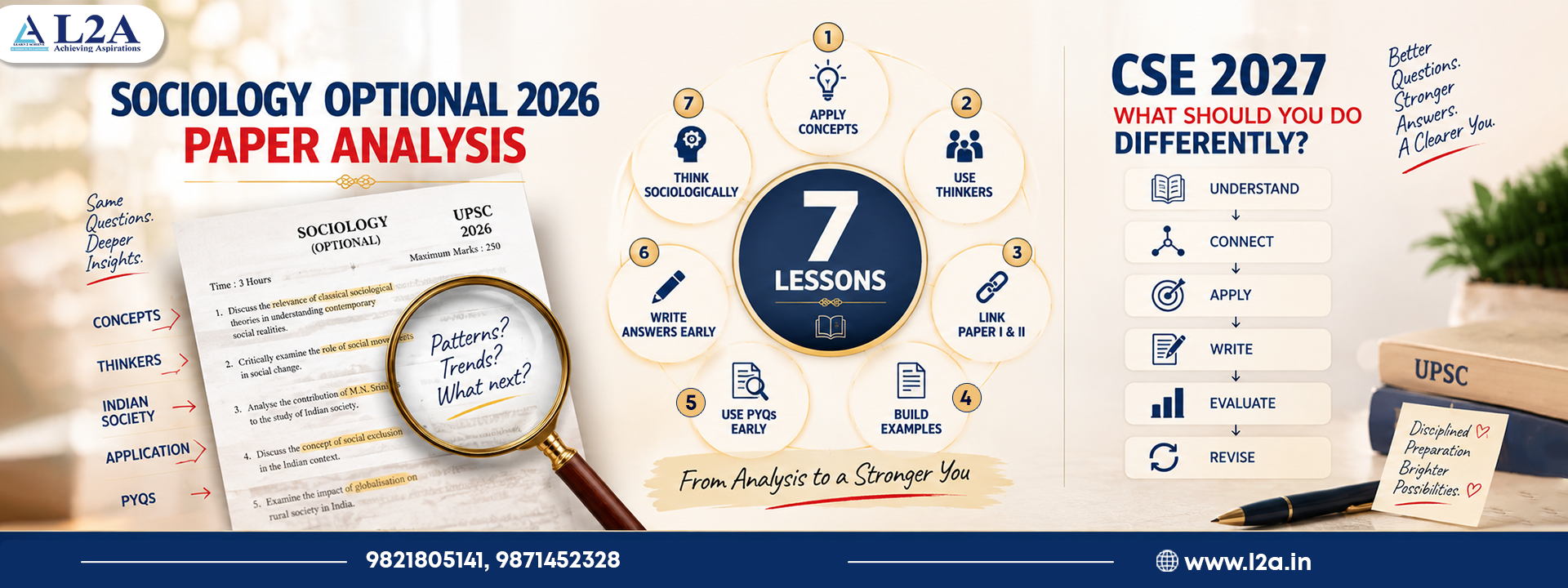
The Sociology Optional 2026 paper is over. But for a 2027 aspirant, the paper is not really over — it has just become a useful guide.
Right now, students are doing what they always do after an exam. Comparing notes with friends. Checking which questions they attempted well and which ones they fumbled. Asking each other, "Was this easy or tough?" Some are relieved, some are worried, and a few are already trying to guess what UPSC will do next year.
Here's the thing — none of that guessing really helps you. What helps is going back to the paper with a clear head and asking better questions. Was the syllabus really different, or did it just feel different? Were the questions predictable if you'd prepared the right way? And most importantly — what does this paper actually tell someone who still has a full year to prepare?
So instead of asking only how difficult Sociology Optional 2026 was, let's ask the more useful question: what does this paper tell a 2027 aspirant about preparation?
Sociology Optional 2026 Paper Analysis: What Did UPSC Actually Test?
Before jumping into individual lessons, it helps to step back and look at the paper as a whole.
Across both papers, one thing stands out clearly — UPSC is not just checking whether you have read the syllabus. It is checking whether you can think with it. Concepts weren't asked in isolation. Thinkers weren't asked as standalone facts. Indian society questions weren't asking for textbook definitions dressed up in Sociology language.
Instead, the demand was to connect a concept to real life, support an argument with a thinker, and back it up with an example that actually fits — not one that's been recycled from a coaching notebook. Answer writing itself needed more than accurate content. It needed structure, application, and a sense of "why does this matter."
Paper I — What Stood Out?
Paper I continues to test the foundation — theory and concepts — but the framing keeps nudging students toward application rather than definition. A thinker's idea is rarely asked in a vacuum. There's an expectation that you can take a concept, place it next to a real situation, and show the interconnection between ideas that are usually studied in separate chapters. The analytical demand is quietly increasing, even when the topic itself feels familiar.
Paper II — What Stood Out?
Paper II keeps its focus on Indian society, but "Indian society" doesn't mean generic statements about caste, class, or gender anymore. It means specific, current, grounded examples. Questions expect you to bring in what's actually happening — social issues, policy context, contemporary developments — rather than repeating the same three examples every student in the country has memorised from a single source.
The bigger picture? Don't just list out what questions were asked. Understand what they reveal about how UPSC wants you to think.
7 Lessons From Sociology Optional 2026 for CSE 2027
This is where the real preparation value lies. Each lesson follows a simple pattern — what happened, what it means, and what you should do about it.
1. Knowing the Concept Is Not Enough Anymore
There's a big difference between knowing a definition and knowing how to use it.
A student who has memorised "anomie means normlessness" knows the topic. A student who can take that same concept and apply it to, say, rising social unrest or changing family structures — that student has actually prepared it.
2027 takeaway: For every major concept, don't stop at the definition. Build it out as Meaning → Thinker → Explanation → Example → Application → Criticism. That's a complete unit, not just a line to memorise.
2. Thinkers Matter, But Their Arguments Matter More
Most students prepare thinkers the same lazy way — name, book title, two lines about what they said. That approach might get you through a prelims-style recall, but Mains doesn't work like that.
Stop treating thinkers as facts to reproduce. Start treating them as tools you can pick up and use to build an argument.
2027 takeaway: Create a Thinker Application Sheet — Thinker → Core argument → Concept → Example → Criticism → Contemporary relevance. When you're stuck on how to develop an answer, this sheet becomes your toolkit.
3. Paper I and Paper II Cannot Be Prepared in Isolation
A lot of students treat Paper I and Paper II like two separate subjects. Big mistake. The theory you study in Paper I is exactly what strengthens your Paper II answers.
Stratification connects directly to caste and class in Indian society. Gender theories give you the framework to write better on Indian women. Theories of social change explain urbanisation and modernisation far more convincingly than a plain descriptive answer ever could. Ideas around power link straight into political institutions and social movements.
2027 takeaway: While you're studying Paper I, keep asking yourself one question — where can I use this in Paper II? That single habit changes how you read theory altogether.
4. Examples Are Becoming More Important in Sociology Answers
Here's a sentence every examiner is tired of reading: "Globalisation has changed Indian society." True, but it says nothing. It's the kind of line that could appear in any GS answer, on any exam, in any year.
What actually strengthens an answer is a specific, current, well-placed example — something drawn from an actual social movement, a government initiative, a recent development, or a genuine Indian case study.
Build an Example Bank, Not Another Huge Notebook
You don't need fifty pages of examples. You need a simple, organised bank you can actually revise.
Structure it like this: Issue → Example → Sociological concept → Thinker → One-line analysis. Five columns, and suddenly your examples become usable instead of just collected.
5. PYQs Should Shape Your Preparation From Day One
Most students treat Previous Year Questions as a revision tool — something to glance at two weeks before the exam. That's a wasted opportunity.
PYQs tell you what UPSC repeatedly tests, how concepts get framed, which thinkers actually show up again and again, what kind of analytical demand exists, and how different topics connect to each other. Read them early, and your entire preparation gets sharper.
2027 takeaway: For every topic you complete, follow this loop — Read → Study PYQs → Identify patterns → Prepare an answer framework. Don't leave this for the end.
6. Answer Writing Has to Start Before You "Finish the Syllabus"
Here's a line almost every aspirant says at some point: "I'll start answer writing once my syllabus is complete."
It sounds logical. It's also one of the most common reasons students run out of time. Sociology answers need more than content — they need introduction, conceptual clarity, a thinker woven in naturally, a clear argument, a relevant example, some critical dimension, and a conclusion that actually closes the answer. That skill doesn't build itself in the final two months. It needs practice, right from the middle of your preparation.
A Simple Sociology Answer Framework
Introduction → Definition/Concept → Thinker → Main Argument → Example → Critical View → Conclusion.
Not every answer needs all seven elements every single time — but knowing this structure means you're never staring at a blank page wondering where to begin.
7. UPSC Wants Sociology, Not Generic GS Answers
This might be the most important lesson on this list.
There's a real difference between a generic GS-style answer and a genuinely sociological one. A sociological answer uses the vocabulary of the subject. It brings in thinkers naturally, not as decoration. It shows multiple perspectives, uses Indian examples with intent, and isn't afraid to add a critical angle where one's needed.
2027 takeaway: Before you finalise any answer, ask yourself one honest question — could this answer have been written by a GS student? If the answer is yes, you need more sociological depth in there.
Sociology Optional 2026 vs Earlier Papers: What Is Actually Changing?
It would be wrong — and honestly a bit dramatic — to say UPSC has completely changed Sociology as a subject. The syllabus remains broadly familiar. What's shifting is the framing of questions and the level of expectation in how you answer them.
|
Area |
Earlier Approach |
Emerging Demand |
|---|---|---|
|
Concepts |
Knowledge |
Application |
|
Thinkers |
Recall |
Arguments + criticism |
|
Paper II |
General examples |
Specific examples |
|
PYQs |
Revision |
Preparation tool |
|
Answers |
Content-heavy |
Analytical |
|
Paper I–II |
Separate |
Interlinked |
A quick honest disclaimer: these are directional observations drawn from analysing the paper, not a statistical prediction of what future UPSC questions will look like. Nobody can promise you that. What this analysis can do is help you prepare in a way that works regardless of exactly how the questions are framed.
What Should a CSE 2027 Aspirant Do Differently?
Knowing what UPSC did is only half the job. The real question is what you do starting tomorrow.
Step 1 — Start With the Syllabus. Go through every topic and sub-topic properly. Don't skip the "smaller" ones assuming they won't be asked.
Step 2 — Map PYQs to the Syllabus. Sit with the syllabus in one hand and PYQs in the other. Identify which themes keep repeating.
Step 3 — Build Thinker Notes. Keep them short and application-focused, not long biographical summaries.
Step 4 — Create an Example Bank. Start it now, and keep adding to it as you come across relevant current examples.
Step 5 — Start Answer Writing Early. Don't wait for 100% syllabus completion — that day never really comes anyway.
Step 6 — Revise Through Questions. Revision should mean writing answers again, not just re-reading old notes.
A Better Sociology Optional Preparation Cycle
Here's a simple way to picture the whole process:
CONCEPT → PYQ → THINKER → EXAMPLE → ANSWER → FEEDBACK → REVISION
You study a concept, check how it's been asked before, attach the relevant thinker to it, add a solid example, write an actual answer, get feedback on it, and then revise based on that feedback. Repeat this cycle for every topic, and your preparation stops feeling scattered.
How L2A Can Help You Prepare Sociology Optional
Preparing Sociology Optional on your own is absolutely possible — plenty of students do it. But if you talk to most aspirants honestly, the struggle usually isn't about reading the syllabus. It's about knowing what to prioritise, how to actually use thinkers in an answer, how to connect Paper I and Paper II without treating them as separate subjects, and how to know if your answers are actually improving.
That's where structured guidance makes a real difference — conceptual clarity sessions, focused answer writing practice, regular test series, and honest evaluation that tells you exactly where you're losing marks.
If you're looking for that kind of structured support, you can explore L2A's Sociology Optional course and pick the programme that fits where you currently are in your preparation. You can also follow Dr. Neha Tiwari's Telegram channel for regular updates, tips, and guidance through your preparation.
Frequently Asked Questions About Sociology Optional 2026
Was Sociology Optional 2026 difficult? Not difficult in the sense of an unfamiliar syllabus — the difficulty came from the framing. Students who had only memorised content found it harder than students who could apply concepts and connect ideas.
What were the major trends in Sociology Optional 2026? Greater emphasis on application over recall, thinkers being used as tools for argument rather than facts to reproduce, specific examples over generic ones, and a visible link between Paper I theory and Paper II answers.
What does Sociology Optional 2026 mean for CSE 2027? It means preparation needs to move beyond reading and note-making. Application, PYQ-based learning, and early answer writing practice matter more than ever.
Should I change my Sociology Optional strategy after the 2026 paper? Not a complete overhaul — refine what you're already doing. Add more application, more examples, and earlier answer writing into your existing plan.
How important are PYQs for Sociology Optional? Very important, and not just for last-minute revision. Use them from day one to understand how UPSC frames questions on each topic.
When should I start answer writing for Sociology Optional? As early as possible — ideally alongside your syllabus coverage, not after it.
How should I prepare Sociology Optional Paper 1 and Paper 2? Together, not separately. While studying a Paper I concept, actively look for where it applies in Paper II, and vice versa.
Is Sociology Optional still a good choice for UPSC? Yes, it remains a solid, scoring-friendly optional for students who prepare it with clarity and application — there's no reliable basis to claim otherwise based on one paper's analysis.
Conclusion — What Should You Remember From Sociology Optional 2026?
2026 is not a paper to fear. It is a paper to learn from.
If there's one preparation philosophy to take away from all of this, it's this simple flow: Understand → Connect → Apply → Write → Evaluate → Revise. Every lesson in this article eventually comes back to that cycle.
For a CSE 2027 aspirant, the biggest advantage is not predicting the next paper. It is becoming ready for whatever form the next paper takes.
If you'd like structured help building this kind of preparation, L2A's Sociology Optional programme is worth exploring.