


Evaluated by faculty only. Personalised feedback on every answer.
Sociology is won in answer writing. In L2A Sociology programmes your answers are checked only by faculty, led by Dr. Neha Tiwari, and each copy comes back with feedback written for you: what earned marks, what lost them, and how to rewrite the answer.
-
Evaluation by faculty only
Every copy is checked by L2A Sociology faculty, led by Dr. Neha Tiwari — not by peers or outsourced evaluators.
-
Personalised feedback
Written comments on your answer: what worked, what cost you marks, and how to rewrite it — not generic remarks.
-
Model answers
Compare your answer with a model answer to see the structure, thinkers and examples UPSC rewards.
-
Improve test by test
Apply the feedback in the next test, so the same mistake does not cost you marks twice in Mains.
Each copy is rated on L2A's feedback sheet:
- Language & articulation
- Structure & presentation
- Contextual competence
- Introduction
- Conclusion
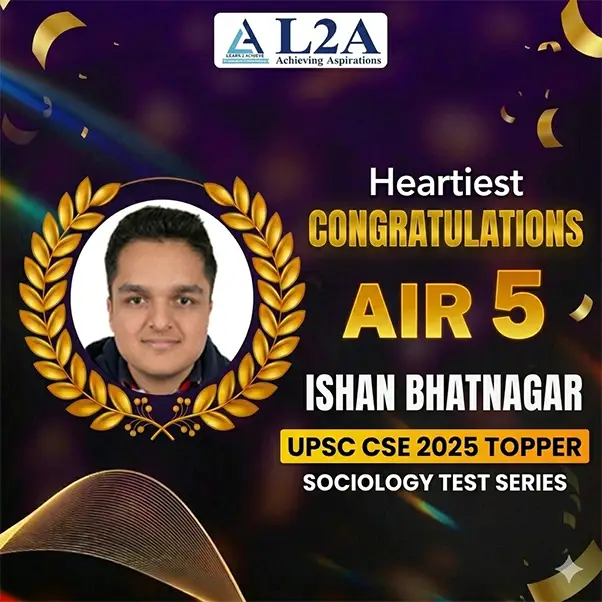
Free: AIR 5 Ishan Bhatnagar's answer copy
His full L2A Sociology test script (Test 07, June 2025) · 52 pages, PDF
Recommended Videos
Watch these sessions to strengthen your preparation and understand key concepts.

20 Marker Answer Writing SECRET Nobody Tells You | UPSC Sociology| L2A IAS
Answer writing
Watch on YouTube
How to Write a 10 Marker Answer | UPSC Sociology Optional | Dr. Neha Tiwari | L2A IAS
Answer writing
Watch on YouTube
UPSC Sociology Optional 2026 Paper Analysis | Trends & Roadmap
Paper analysis / trends
Watch on YouTube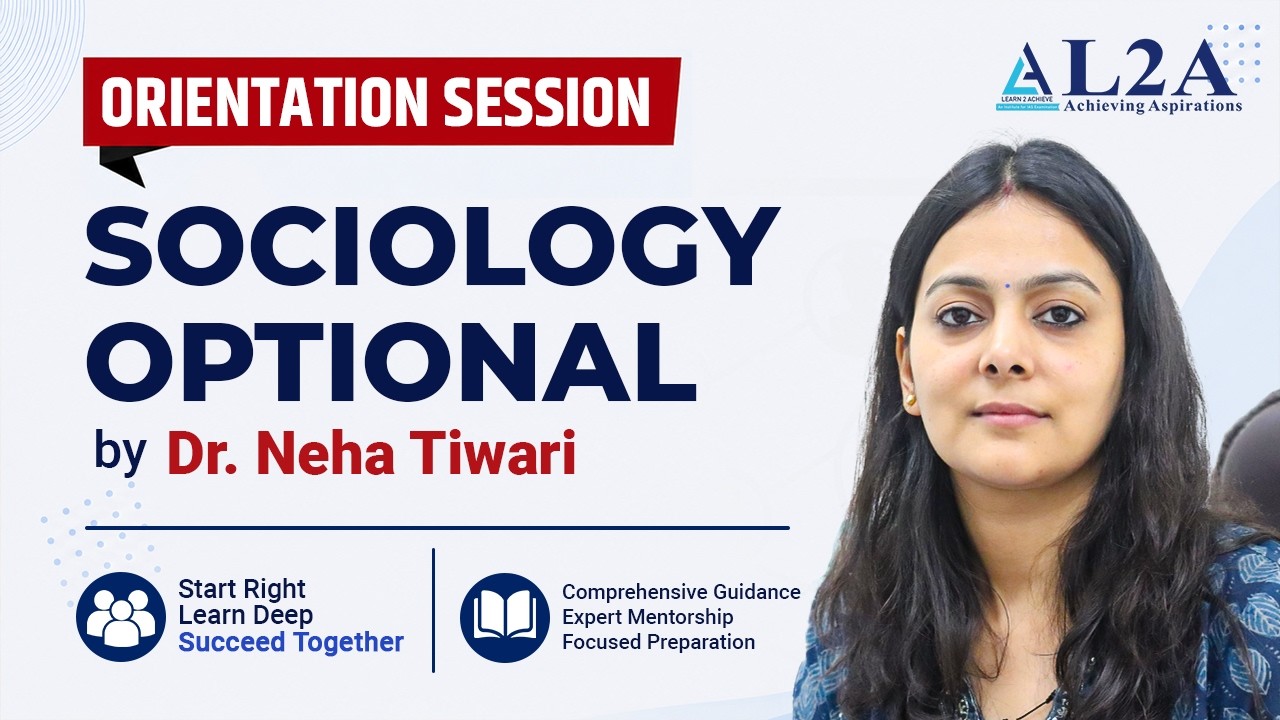
Sociology Optional Orientation Session | Dr. Neha Tiwari Ma’am
Sociology orientation
Watch on YouTube
| Introduction | Syllabus | Exam Pattern | Why L2A | Our Achiever | Videos | Course New |
Sociology Optional for UPSC – Complete Guide

Introduction – Sociology Optional for UPSC CSE
Sociology is a great optional subject for the UPSC Civil Services Examination (CSE), especially for those who are curious about society and human behavior. It helps aspirants understand topics like social change, caste, class, gender, globalization, and social movements. Since Sociology is closely related to real-life issues, it also supports General Studies, Essay writing, and even the Interview stage.
One of the biggest reasons why many aspirants choose Sociology is its short and manageable syllabus, scoring potential, and relevance to current affairs. The subject is easy to understand and does not require a background in Sociology. Whether it’s studying Indian society or global social trends, this subject offers both theory and practical insights.
Overview of UPSC Sociology Optional
Sociology is one of the optional subjects available in the UPSC Civil Services Mains Examination. It consists of two papers – Paper I and Paper II, covering a wide range of topics related to society, social structures, and human interactions. The syllabus includes key areas such as social change, caste, class, gender, globalization, social institutions, and Indian society, providing aspirants with deep insights into how societies function and evolve.
Choosing Sociology as an optional subject helps candidates understand societal dynamics, governance, and policy-making, which are highly relevant for civil services. Its interdisciplinary nature, concise syllabus, and direct application in General Studies and Essay writing make it a popular and strategic choice for UPSC aspirants.
Why Choose Sociology Optional for UPSC?
Sociology is a high-scoring and analytical optional subject for the UPSC Civil Services Mains Examination. Its structured approach, relevance to contemporary issues, and accessibility make it a preferred choice for many aspirants.
Dr. Neha Tiwari, a renowned Sociology faculty at L2A Coaching Institute, provides expert guidance through:
- Sociology Optional Foundation programme
- Sociology Optional Test Series
- Answer Writing Guidance Programme
Comprehensive Sociology Syllabus for UPSC
Paper I: Sociological Theories and Fundamentals
Paper I focuses on foundational concepts, methodologies, and key thinkers.
-
Sociology - The Discipline
- Modernity and social changes in Europe and emergence of Sociology.
- Scope of the subject and comparison with other social sciences.
- Sociology and common sense.
-
Sociology as Science
- Science, scientific method, and critique.
- Major theoretical strands of research methodology.
- Positivism and its critique.
- Fact value and objectivity.
- Non-positivist methodologies.
-
Research Methods and Analysis
- Qualitative and quantitative methods.
- Techniques of data collection.
- Variables, sampling, hypothesis, reliability, and validity.
-
Sociological Thinkers
- Karl Marx: Historical materialism, mode of production, alienation, class
- Emile Durkheim: Division of labour, social fact, suicide, religion and society.
- Max Weber: Social action, ideal types, authority, bureaucracy, protestant ethic and the spirit of capitalism.
- Talcott Parsons: Social system, pattern variables.
- Robert K. Merton: Latent and manifest functions, conformity and deviance, reference groups.
- Mead: Self and identity.
-
Stratification and Mobility
- Concepts: equality, inequality, hierarchy, exclusion, poverty, and deprivation.
- Theories of social stratification: Structural functionalist theory, Marxist theory, Weberian theory.
- Dimensions:Social stratification of class, status groups, gender, ethnicity and race.
- Social mobility: open and closed systems, types of mobility, sources and causes of mobility.
-
Works and Economic Life
- Social organization of work in different types of society: slave society, feudal society, industrial capitalist society.
- Formal and informal organization of work.
- Labour and society.
-
Politics and Society
- Sociological theories of power.
- Power elite, bureaucracy, pressure groups and political parties.
- Nation, state, citizenship, democracy, civil society, ideology.
- Protest, agitation, social movements, collective action, revolution.
-
Religion and Society
- Sociological theories of religion.
- Types of religious practices: animism, monism, pluralism, sects, cults.
- Religion in modern society: religion and science, secularization, religious revivalism, fundamentalism.
-
Systems of Kinship
- Family, household, marriage.
- Types and forms of family.
- Lineage and descent.
- Patriarchy and sexual division of labour.
- Contemporary trends.
-
Social Change in Modern Society
- Sociological theories of social change.
- Development and dependency.
- Agents of social change.
- Education and social change.
- Science, technology, and social change.
Paper II: Indian Society - Structure and Change
This paper focuses on Indian societal structures, historical evolution, and contemporary issues.
-
Perspectives on the Study of Indian Society
- Indology (G.S. Ghurye)
- Structural functionalism (M.N. Srinivas)
- Marxist sociology (A.R. Desai)
-
Impact of colonial rule on Indian society
- Social background of Indian nationalism.
- Modernization of Indian tradition.
- Protests and movements during the colonial period.
- Social reforms.
-
Rural and Agrarian Social Structure
- The idea of Indian village and village studies
- Agrarian social structure: evolution of land tenure system, land reforms.
-
Caste System
- Perspectives on the study of caste systems: G. S. Ghurye, M. N. Srinivas, Louis Dumont, Andre Beteille.
- Features of caste system.
- Untouchability-forms and perspectives
-
Tribal Communities in India
- Definitional problems.
- Geographical spread.
- Colonial policies and tribes.
- Issues of integration and autonomy.
-
Social Classes in India
- Agrarian class structure.
- Industrial class structure.
- Middle classes in India.
-
Systems of Kinship in India
- Lineage and descent in India.
- Types of kinship systems.
- Family and marriage in India.
- Household dimensions of the family.
- Patriarchy, entitlements, and sexual division of labour.
-
Religion and Society
- Religious communities in India.
- Problems of religious minorities.
-
Visions of Social Change in India
- Idea of development planning and mixed economy.
- Constitution, law, and social change.
- Education and social change.
-
Rural and Agrarian Transformation in India
- Programmes of rural development, Community Development Programme, cooperatives, poverty alleviation schemes.
- Green revolution and social change.
- Changing modes of production in Indian agriculture.
- Problems of rural labour, bondage, migration.
-
Industrialization and Urbanisation in India
- Evolution of modern industry in India.
- Growth of urban settlements in India.
- Working class: structure, growth, class mobilization.
- Informal sector, child labour.
- Slums and deprivation in urban areas.
-
Politics and Society
- Nation, democracy and citizenship.
- Political parties, pressure groups, social and political elite.
- Regionalism and decentralization of power.
- Secularization.
-
Social Movements in Modern India
- Peasants and farmers' movements.
- Women’s movement.
- Backward classes & Dalit movements.
- Environmental movements.
- Ethnicity and Identity movements.
-
Population Dynamics
- Population size, growth, composition and distribution.
- Components of population growth: birth, death, migration.
- Population Policy and family planning.
- Emerging issues: ageing, sex ratios, child and infant mortality, reproductive health.
-
Challenges of Social Transformation
- Crisis of development: displacement, environmental problems and sustainability.
- Poverty, deprivation and inequalities.
- Violence against women.
- Caste conflicts.
- Ethnic conflicts, communalism, religious revivalism.
- Illiteracy and disparities in education.
Sociology Optional Exam Pattern for UPSC Mains
| Paper | Marks | Questions | Compulsory | Choice | Duration |
|---|---|---|---|---|---|
| Paper I | 250 | 5 | Q1 & Q5 | Choose 3 | 3 Hours |
| Paper II | 250 | 5 | Q1 & Q5 | Choose 3 | 3 Hours |
Sociology Optional Programme at L2A Coaching Institute
-
Sociology Optional Foundation
Enroll NowA structured course covering Paper I & II with in-depth conceptual clarity, real-life examples, and contemporary applications.
-
Sociology Optional Test Series
Enroll NowIncludes full-length and sectional tests to assess performance, improve answer writing, and enhance speed & accuracy.
-
Answer Writing Guidance Programme
Enroll Now- Weekly practice sessions
- Personalized feedback from Dr. Neha Tiwari
- Handwritten model answers
Why Choose L2A Coaching Institute?
- Evaluation by Faculty Only: every answer copy is checked by L2A Sociology faculty, led by Dr. Neha Tiwari – not by peers or outsourced evaluators
- Personalised Feedback: written comments on your own answers – what earned marks, what lost them and how to rewrite
- Expert Faculty: Dr. Neha Tiwari’s experience and mentorship – meet Dr. Neha Tiwari
- Updated Content: Aligned with latest UPSC trends
- Comprehensive Resources: Notes, video lectures, and answer writing guidance
Start Your Sociology Optional Journey with L2A Today!
Master the UPSC Sociology syllabus with expert guidance and strategic preparation. Enroll now and take a step towards success in UPSC Civil Services Examination!
A top-5 All-India Rank from the L2A Sociology Test Series
Ishan Bhatnagar · AIR 5, UPSC CSE 2025
Ishan Bhatnagar secured AIR 5 in UPSC CSE 2025. He wrote his Sociology tests in the L2A Sociology Test Series, where every answer copy is evaluated by faculty only, led by Dr. Neha Tiwari, and comes back with personalised feedback.
- L2A Sociology Test Series student
- Copies evaluated by faculty only
- Personalised feedback on every test