

Crack Sociology Optional 2027: Your Step-by-Step Preparation Roadmap
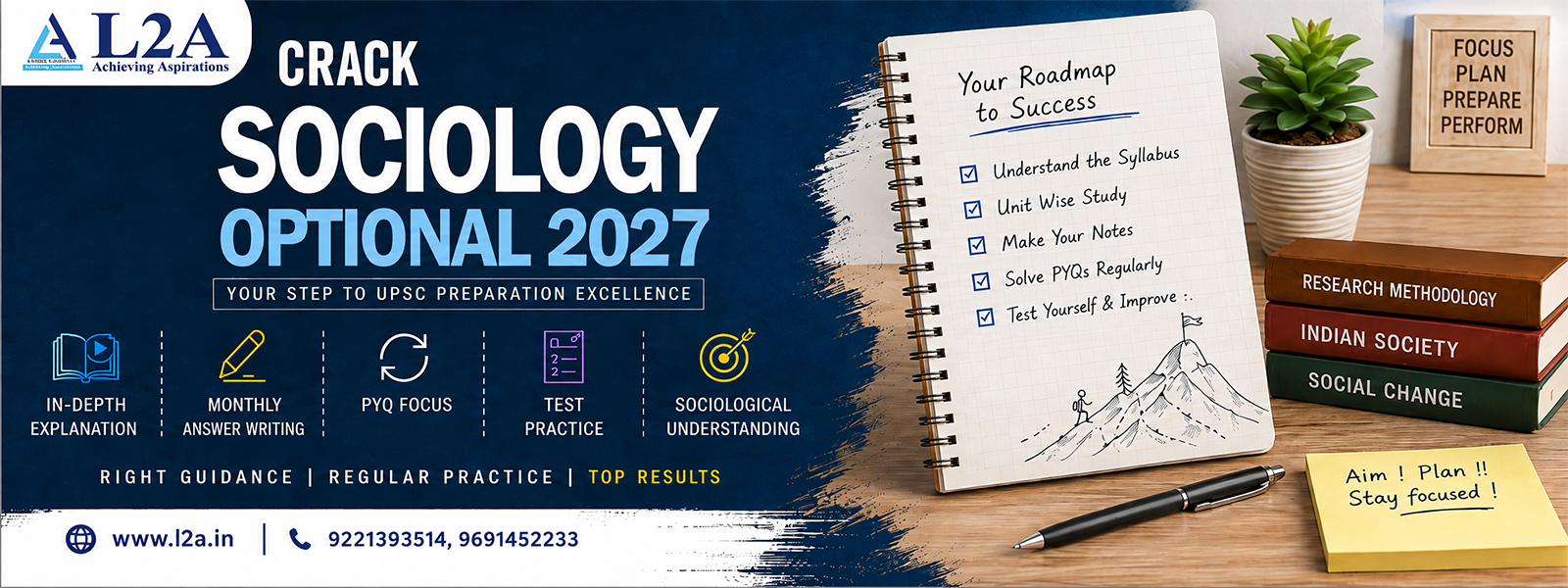
From Syllabus and PYQs to Answer Writing, Revision and Test Practice
If you have just decided to take Sociology Optional for UPSC CSE 2027, the first few days are usually confusing. You know the syllabus is "manageable," you have heard it overlaps with GS, and maybe a senior told you it is "scoring." But none of that tells you what to actually do on Monday morning.
This article is written to answer that exact question. Not in a motivational way, but in a working, step-by-step way — the kind of roadmap a faculty member would sketch on a whiteboard while explaining Sociology Optional 2027 preparation to a batch of new aspirants.
We will walk through the syllabus, a realistic phase-wise roadmap, how to use PYQs from day one, how to build notes that you can actually revise, and how to test yourself before you reach the Mains hall. Let's begin.
Why Sociology Optional Can Be a Smart Choice for UPSC 2027
Sociology has a syllabus that is genuinely shorter than most optionals. That much is true. But "shorter" does not mean "easier" — it means the depth expected from you per topic is higher, because UPSC assumes you have covered the limited syllabus thoroughly.
There are real advantages, though. The subject is conceptual, so once you understand a theory or a thinker properly, you can apply it to multiple questions. There is strong overlap with GS Paper 1 (Indian Society, social issues) and GS Paper 2 (Social Justice), which means your optional preparation quietly strengthens your GS answers too. Essay writing also benefits, since sociological concepts like social change, modernisation and gender give you frameworks to structure arguments.
The subject also connects naturally with everyday Indian society — caste, family, religion, urbanisation — topics you already have some intuitive sense of. That intuitive sense is a starting point, not a substitute for structured study.
What Sociology does demand, more than most optionals, is answer writing. You cannot clear this paper by reading well. You clear it by writing well, consistently, from an early stage. Keep that in mind as we go further.
Who Should Choose Sociology Optional?
Is Sociology Suitable for Beginners?
Yes, and this is one reason it remains a popular optional. You don't need prior exposure to sociology as a subject. What you need is comfort with reading conceptual material and the discipline to convert theory into structured answers.
Can Engineers and Science Graduates Choose Sociology?
Engineers and science graduates choose Sociology Optional every year, and many do well. The subject rewards logical structuring of answers — thinker, concept, example, criticism — which is a skill, not a background requirement. If anything, a fresh mind sometimes grasps sociological concepts faster because there is no need to unlearn anything.
Do You Need a Sociology Background?
It helps marginally in the first month, mainly because terminology feels familiar. But by Month 2, everyone is on the same footing. Faculty across coaching institutes will tell you the same thing — background gives a small head start, not a lasting advantage.
When Should You Reconsider Your Optional Choice?
If you genuinely dislike reading theory and prefer memorisation-based subjects, or if you are choosing Sociology only because "it is scoring" without reading even the syllabus once, pause and reconsider. An optional chosen without any personal comfort with the subject usually shows up as inconsistent motivation by Month 3 or 4.
Understand the Sociology Optional Syllabus First
Before building any strategy, sit with the syllabus for a full day. Not to memorise it, but to get a sense of its shape.
Sociology Paper 1
Paper 1 is the theoretical foundation. It covers the discipline of sociology, sociological thinkers (Marx, Weber, Durkheim, Parsons, Mead and others), research methods, social stratification, social change, and core concepts like social structure, culture, socialisation, and social institutions like family, marriage, kinship, religion and economy.
Think of Paper 1 as your toolbox. Every concept and thinker you study here becomes a tool you will use to answer Paper 2 questions.
Sociology Paper 2
Paper 2 is about Indian society — its structure, and the process of change happening within it. It covers rural and agrarian transformation, caste and class, tribal society, women and society, population dynamics, urbanisation, social movements, and issues of development, environment and globalisation in the Indian context.
Paper 2 is where your Paper 1 toolbox gets used. A question on farmer suicides is really a question about agrarian distress, but a good answer will bring in concepts like relative deprivation, social exclusion or Marxist class analysis.
Why Syllabus Mapping Matters
Here is a simple framework that will save you a lot of directionless reading:
Syllabus → Topic → PYQ → Notes → Answer
For every topic in the syllabus, immediately check what has been asked from it in the last 10–15 years. This single habit changes how you read. You stop reading everything with equal intensity and start reading with a sense of what actually gets tested. We will come back to this in detail in the PYQ section.
The Sociology Optional 2027 Preparation Roadmap
There is no single "correct" number of months for Sociology Optional. Someone starting in mid-2025 has a different pace than someone starting in early 2026. What matters is that your preparation moves through these phases in order, without skipping the PYQ and answer-writing stages.
Phase 1 — Build Your Foundation
Roughly the first 1–2 months. Focus on understanding what sociology is as a discipline, basic terminology, and getting comfortable with the language of the subject. Don't rush into thinkers yet — get your basics of concepts like society, culture, institution and structure clear first.
Phase 2 — Complete the Syllabus
Around Month 3–4, move into a structured first reading of both papers. This is not the deep-dive stage; this is the stage where you build a working understanding of every topic at least once.
Phase 3 — Integrate PYQs
Starting around Month 4–5, and really from the moment you finish your first topic, PYQs should enter your study routine. By this phase, PYQ analysis should be a regular weekly habit, not an afterthought before Mains.
Phase 4 — Start Answer Writing
This does not wait for syllabus completion. Ideally, answer writing runs parallel to Phase 2 and 3. The moment you finish a topic and its PYQs, write at least one answer from it.
Phase 5 — Revision and Tests
Once your first full reading of the syllabus is done, shift into structured revision cycles combined with sectional and full-length tests. This usually begins a few months before Mains.
Phase 6 — Prelims and Post-Prelims Strategy
Sociology preparation typically slows down (not stops) during the 6–8 weeks before Prelims, since GS and CSAT need focused attention. A light touch — revising notes, staying updated with current affairs relevant to sociology — is enough during this window. Post-Prelims, Sociology preparation returns to full intensity with tests and rigorous answer writing until Mains.
Don't treat these month numbers as fixed rules. A working professional with 3 hours a day will naturally take longer than a full-time aspirant with 6 hours a day. What matters is the sequence, not the calendar.
Step 1 — Build Your Sociology Foundation
Start With Concepts, Not Memorisation
A common mistake among beginners is trying to memorise definitions before understanding the idea behind them. Take Sanskritization as an example, since it is one of the most frequently tested concepts in Sociology Optional.
M.N. Srinivas developed this concept to explain how a lower caste or tribal group adopts the customs, rituals, and lifestyle of a upper or "twice-born" caste to claim higher social status. The features to know: it is a process of cultural mobility, not necessarily structural mobility; it often involves adopting vegetarianism, teetotalism or particular religious practices; and it works within the caste hierarchy rather than challenging it.
The criticism matters just as much — scholars have pointed out that Sanskritization does not challenge the caste system, it only allows movement within it, and that it largely ignores the experience of Dalits who face a different kind of mobility altogether. Contemporary relevance could include reservation debates or the rise of Dalit assertion movements that reject Sanskritization as a strategy.
Notice what happened here. A single concept, once understood properly with meaning, features, criticism and relevance, becomes a ready-made answer structure. This is what "conceptual clarity" actually means in Sociology Optional preparation — not knowing the definition, but knowing how to build an answer around it.
Step 2 — Study Sociology Thinkers the Right Way
Thinkers form the backbone of Paper 1, but reading them like a textbook biography — early life, major works, later life — wastes time. UPSC does not ask "Discuss the life of Max Weber." UPSC asks how his ideas apply to a given theme.
Use this framework for every thinker: Concept → Theory → Keywords → Criticism → Application → PYQ
Karl Marx
Focus on historical materialism, class conflict, alienation and mode of production. Keywords: base-superstructure, false consciousness, surplus value. Application: caste as a form of class in India, labour and informal economy questions.
Max Weber
Focus on social action, verstehen, bureaucracy, and the Protestant Ethic. Keywords: ideal type, rationalisation, legitimate authority. Application: bureaucratic functioning in India, religion and economic development debates.
Emile Durkheim
Focus on social facts, division of labour, anomie, and his study of suicide. Keywords: mechanical and organic solidarity, collective conscience. Application: questions on social integration, modern anomie, changing family structures.
Talcott Parsons
Focus on structural functionalism, pattern variables, and social system. Keywords: AGIL framework, equilibrium. Application: institutional analysis questions, family and role differentiation.
George Herbert Mead
Focus on symbolic interactionism, the self, "I" and "me," and role-taking. Keywords: significant others, generalised other. Application: socialisation questions, identity formation in Indian context.
Indian Thinkers
G.S. Ghurye, M.N. Srinivas, A.R. Desai, D.P. Mukerji and Yogendra Singh deserve special attention because they connect Western theory to Indian realities. Their frameworks are what actually make your Paper 2 answers analytical rather than descriptive.
Don't try to master every thinker with equal depth in the first pass. Build core familiarity with all of them, then deepen your understanding of the more frequently tested ones through PYQs — which brings us to the next, and arguably the most important, step.
Step 3 — Use PYQs From Day One
This is where most Sociology Optional 2027 aspirants lose time without realising it.
Don't Wait Until Syllabus Completion
Don't wait until you finish the syllabus to open the PYQs. Read the PYQs for a topic immediately after completing that topic. You will quickly understand what UPSC actually expects from that area and what depth is genuinely necessary — and what you can safely leave for later.
Categorise PYQs Topic-Wise
Go through the last 10–12 years of Sociology Optional PYQs and sort them by syllabus topic, not by year. A topic-wise PYQ file tells you instantly which areas are asked almost every year (social stratification, family, social movements) and which are asked occasionally.
Identify Repeated Themes
UPSC may change the wording, but themes often remain connected. A question on "Sanskritization as a means of social mobility" and a later question on "caste system and social mobility" are really testing the same underlying understanding, phrased differently. Once you notice this pattern, PYQs stop feeling random.
Understand Changing Question Framing
Older PYQs tend to be more direct — "Discuss X." Recent PYQs often ask you to link a concept with a contemporary issue, or ask for a critical examination rather than a description. Track this shift; it tells you how to frame your own answers now.
Convert PYQs Into Micro-Notes
For every PYQ, write a two-line answer skeleton — not a full answer, just the structure you would use. Over time, this becomes a ready reference that is far more useful during revision than rereading a textbook chapter.
Step 4 — Make Short, Revision-Friendly Notes
Follow the One-Source Principle
Pick one primary source per topic — a standard textbook, class notes, or a reliable compilation — and treat everything else as supplementary. Aspirants who juggle four sources for the same topic usually end up with longer notes and less clarity, not more.
Keep Notes Syllabus-Based
Structure your notes exactly as the syllabus is structured, topic by topic. This makes cross-referencing with PYQs and revision far easier than notes organised by "what I read this week."
Add Thinkers and Examples
Every conceptual note should carry the relevant thinker's name and at least one Indian example. A note on "social change" without a thinker attached to it is incomplete for Sociology Optional purposes.
Update Notes Through PYQs
As you go through PYQs, add new angles or examples you hadn't considered to the existing notes rather than creating a separate PYQ notebook that you never revisit.
Don't Make Notes That Take Three Days to Revise
If a single topic's notes run into ten pages, you have written a summary, not a note. Good Sociology Optional notes should let you revise an entire topic in 15–20 minutes closer to Mains. If they don't, trim them.
Step 5 — Start Sociology Answer Writing Early
What Should a Sociology Answer Contain?
A well-rounded Sociology Optional answer typically has: a short introduction, definition or context of the concept, the relevant thinker, the core argument, at least one concrete example (preferably Indian), a line of criticism or a counter-view, contemporary relevance, and a brief conclusion that ties back to the question. Not every answer needs every element in equal weight, but this structure is a reliable default.
What Makes a Sociology Answer Different From a GS Answer?
This is where many aspirants struggle even after months of preparation. A GS answer on, say, urbanisation, will discuss facts, government schemes and general observations. A Sociology Optional answer on the same theme must demonstrate sociological thinking — using concepts like social disorganisation, changing kinship patterns, or Louis Wirth's idea of urbanism as a way of life. The examiner is not looking for what you know about urban India; they are looking for how sociologically you can analyse it.
How Many Answers Should You Practise?
There is no magic number, and claims of "500 answers before Mains" are usually exaggerated. A realistic target is writing answers regularly enough that by the time you reach full-length tests, writing a 150 or 250-word answer within the time limit feels natural rather than stressful. For most aspirants, that means a few answers every week from the point you start Phase 4 onward, increasing in frequency as Mains approaches.
Move from notes to evaluated Sociology answers
Once concepts are clear, lock the habit with Daily Answer Writing and Sociology Mains Test Series under faculty evaluation.
Step 6 — Integrate Current Affairs With Sociology
Current affairs should support your sociological concepts, not become a separate burden you track independently. When you read about a new government report on gender, a viral piece on migrant labour, or a court judgment on tribal rights, ask one question: which concept does this connect to?
- Caste — reservation debates, dominant caste politics, caste census discussions
- Gender — workforce participation data, gender budgeting, changing family roles
- Family — live-in relationships, nuclear family trends, elder care
- Urbanisation — smart cities, informal settlements, urban migration patterns
- Globalisation — gig economy, cultural homogenisation debates
- Social movements — farmer protests, identity-based movements
- Tribal issues — forest rights, displacement, PESA-related developments
- Education — NEP implementation, digital divide in learning
- Population — census delays, demographic dividend debates
- Technology — social media and social change, digital surveillance debates
Maintain a small running file of such examples under each syllabus topic. This becomes your answer enrichment material closer to Mains.
Step 7 — Build Your Answer Enrichment Toolkit
Thinkers
Keep a one-page summary sheet per major thinker with their core concept and one likely application area.
Sociological Keywords
Build a running glossary — terms like anomie, relative deprivation, cultural lag, social capital — that you can drop naturally into answers to signal conceptual clarity.
Indian Examples
Collect examples from Indian society reports, NFHS data, Census findings, or well-known sociological studies conducted in India.
Government Reports and Data
Familiarity with reports like the Economic Survey, NFHS, PLFS, and Census data adds credibility to Paper 2 answers, especially on population, gender and employment themes.
Case Studies
Real events — a specific social movement, a particular community's experience — give your answers texture that generic statements cannot.
Diagrams and Flowcharts
For concepts like Parsons' AGIL framework or Marx's base-superstructure model, a simple diagram in the answer can communicate structure faster than a paragraph, and examiners notice this.
Current Affairs Examples
Keep two or three recent, well-verified examples per major theme rather than a large, unmanageable list you will never use in the exam hall.
Step 8 — Sociology Optional Revision Strategy
Revision 1 — Understanding and Consolidation
The first revision, right after completing the syllabus, is about consolidating your understanding. Go through your notes topic by topic and check whether you can explain each concept without opening the book.
Revision 2 — PYQ-Based Revision
The second revision should be driven entirely by your PYQ file. For every topic, revise by first recalling what has been asked from it, then checking whether your notes and answer skeletons cover those angles.
Revision 3 — Answer-Oriented Revision
Closer to Mains, revision should shift to writing full or partial answers from memory, then comparing them against your notes. Simply rereading notes at this stage gives a false sense of preparedness. Active recall — trying to reproduce the answer before checking — is what actually strengthens retention and speed.
Step 9 — Test Yourself Before UPSC Mains
Reading and writing in isolation only takes you so far. At some point, your preparation needs to be tested under conditions close to the real exam.
Topic Tests
Short tests after completing individual topics help you catch gaps early, when they are still easy to fix.
Sectional Tests
Once a broader section — say, all of social stratification, or the full family and kinship section — is complete, a sectional test tells you how well the pieces connect.
Half-Length Tests
These simulate half a paper under time pressure and are useful once you have a reasonable base across most of the syllabus.
Full-Length Tests
Full-length tests, closer to Mains, are non-negotiable. They train you in time management, question selection, and writing speed — all under the exact pressure you will face on the actual exam day.
Testing is also where evaluation becomes critical. Getting your answers checked by someone experienced helps you identify patterns you cannot see yourself — repeated mistakes, weak structuring, or gaps in application. This is one reason structured test series, like the L2A Sociology Mains Test Series, are useful closer to Mains — not to "predict" questions, but to build the discipline of writing under real exam conditions and getting honest, detailed feedback on where your answers are falling short.
How to Balance Sociology Optional With GS
Balancing time between Sociology Optional and GS changes across the year. Here's a rough guide, though your own numbers may differ based on your strengths.
|
Preparation Stage |
Sociology |
GS |
|
Foundation |
2–3 hrs |
4–5 hrs |
|
Syllabus Completion |
Around 3 hrs |
Around 4 hrs |
|
Revision |
2–3 hrs |
Around 4 hrs |
|
Post-Prelims |
4–5 hrs |
4–5 hrs |
These are examples, not fixed rules. If your GS foundation is already strong from a previous attempt, you may naturally shift more hours toward Sociology, and vice versa.
Sociology Optional Timetable for 2027 Aspirants
Timetable for a Full-Time Aspirant
A realistic day might look like 2 hours for Sociology reading in the morning, 3–4 hours for GS through the day, 1 hour for current affairs, and 1–2 hours for answer writing or revision in the evening — with one full day a week kept lighter for catching up or resting. Stretching this to 14–16 hours daily is neither sustainable nor necessary; consistency over months matters far more than intensity over a few days.
Timetable for a Working Professional
With limited hours, protect your evenings and weekends deliberately. A workable pattern is 1–1.5 hours of focused Sociology study on weekdays, with weekends used for answer writing, PYQ analysis and revision in longer blocks of 3–4 hours. Progress will be slower than a full-time aspirant's, and that is fine, as long as the weekly rhythm doesn't break.
Common Mistakes in Sociology Optional Preparation
Reading without PYQs — leads to unfocused study. Fix: introduce PYQs from the very first topic you complete.
Making huge notes — becomes unrevisable later. Fix: cap each topic's notes to a few pages, focused on structure over detail.
Using too many sources — creates confusion and duplication. Fix: stick to one primary source per topic, use others only for clarification.
Ignoring Paper 2 — many aspirants over-invest in Paper 1 theory and under-prepare Indian society topics. Fix: allocate equal, deliberate time to Paper 2 from the syllabus-completion phase itself.
Writing generic GS answers — losing marks despite good content because the answer lacks sociological framing. Fix: consciously insert a thinker or concept into every Paper 2 answer.
Memorising thinkers without understanding — answers sound listy and disconnected. Fix: use the concept-to-application framework discussed earlier, every time.
Starting answer writing too late — leaves no time to improve before Mains. Fix: begin writing from Phase 2 itself, even if the first answers are rough.
Never getting answers evaluated — self-assessment has blind spots. Fix: get answers checked periodically, ideally by someone experienced with the paper.
Not revising — a single reading fades quickly under exam pressure. Fix: build revision cycles into your calendar from the start, not as an afterthought.
Copying model answers instead of developing analytical thinking — produces answers that don't sound like your own thinking under exam conditions. Fix: use model answers to understand structure, then write your own version in your own words.
How L2A Academy Can Help With Sociology Optional 2027
If you are looking for structured guidance rather than preparing entirely on your own, L2A Academy's Sociology Optional programme is built around the same roadmap discussed in this article — structured syllabus coverage for both papers, PYQ-oriented teaching so you understand what UPSC actually expects, regular answer writing practice, and detailed evaluation of your written work.
The programme is guided by faculty members with deep experience in Sociology Optional teaching, including Dr. Neha Tiwari, whose classes focus on building conceptual clarity alongside exam-oriented answer writing rather than just covering content. Mentorship support is also available for aspirants who want regular feedback on their preparation strategy, not just their answers.
Closer to Mains, the L2A Sociology Mains Test Series gives you a structured way to test your preparation under real exam conditions, with evaluation that points out specific, fixable gaps in your answers. You can check the details of the Sociology Mains Test Series here.
None of this replaces your own effort — no test series or coaching programme can guarantee a rank. What structured guidance does is reduce the time you spend figuring things out alone, so more of your time goes into actual preparation.
Walk the Sociology 2027 roadmap with L2A
Foundation coverage with Dr. Neha Tiwari, answer-writing culture, and a Mains Test Series that mirrors UPSC demand — without rebuilding the system alone.
Final Sociology Optional 2027 Checklist
☐ Syllabus completed
☐ PYQs mapped
☐ Paper 1 revised
☐ Paper 2 revised
☐ Thinkers prepared
☐ Current examples collected
☐ Short notes ready
☐ Answer writing started
☐ Sectional tests completed
☐ Full-length tests completed
☐ Weak areas identified
☐ Multiple revisions completed
Frequently Asked Questions
Is Sociology Optional good for UPSC 2027?
Yes, for aspirants comfortable with conceptual reading and consistent answer writing. It has a manageable syllabus and strong overlap with GS, but it is not automatically easier than other optionals — success still depends on disciplined preparation.
How many months are enough for Sociology Optional?
There is no fixed number. Most aspirants need somewhere between 8 and 12 months of consistent preparation, including revision and test practice, though this varies based on daily study hours and prior familiarity with the subject.
Can I prepare Sociology Optional without a Sociology background?
Yes. A large number of successful candidates come from engineering, science and commerce backgrounds. What matters more is consistent effort and a habit of converting concepts into structured answers.
How should I start Sociology Optional from scratch?
Begin with basic terminology and core concepts — society, culture, structure, institution — before moving to thinkers. Read the syllabus alongside a standard textbook and start checking PYQs from your very first topic.
Is Sociology Optional scoring?
Sociology has produced consistently good results over the years, but "scoring" depends heavily on the quality of your answer writing, not just how well you know the theory. Two aspirants with similar content knowledge can get very different marks based on structure and application.
How important are PYQs in Sociology Optional?
Extremely important. PYQs tell you what depth UPSC expects from each topic and reveal recurring themes that guide your notes and answer practice throughout your preparation.
When should I start answer writing?
As early as possible — ideally alongside your first reading of each topic, not after finishing the whole syllabus. Early, imperfect answers improve faster than answers you start writing only a few weeks before Mains.
How should I prepare Paper 1 and Paper 2?
Treat Paper 1 as your conceptual toolbox and Paper 2 as the space where you apply that toolbox to Indian society. Give both papers deliberate, roughly equal attention rather than over-focusing on one.
How many hours should I study Sociology Optional daily?
This depends on your overall UPSC schedule, but 2–4 hours daily during syllabus completion, adjusted up or down around Prelims and Mains, is a realistic range for most aspirants balancing Sociology with GS.
Is coaching necessary for Sociology Optional?
Not strictly necessary, but structured guidance — whether through coaching, mentorship or a good test series — helps many aspirants save time on figuring out what to study and how to write, especially for evaluation and feedback that self-study cannot provide on its own.
Final Word
Don't try to finish Sociology Optional as quickly as possible. The aspirants who do well in this paper are not the ones who complete the syllabus fastest — they are the ones who build a working system: understand the concept, check the PYQ, make a short note, write the answer, test yourself, and revise. Repeat that cycle honestly across both papers, and your Sociology Optional 2027 preparation will hold up under real exam pressure.
If you want structured support through this process — from syllabus coverage to evaluated test practice — L2A Academy's Sociology Optional programme and Mains Test Series are built to walk alongside exactly this roadmap.
Start your Sociology Optional 2027 plan with L2A
Enquire about foundation batches, mentorship, and Sociology Test Series — structured for syllabus → PYQ → answer writing → tests.