

UPSC Mains Answer Writing Strategy for Anthropology & Sociology: How to Write High-Scoring Answers
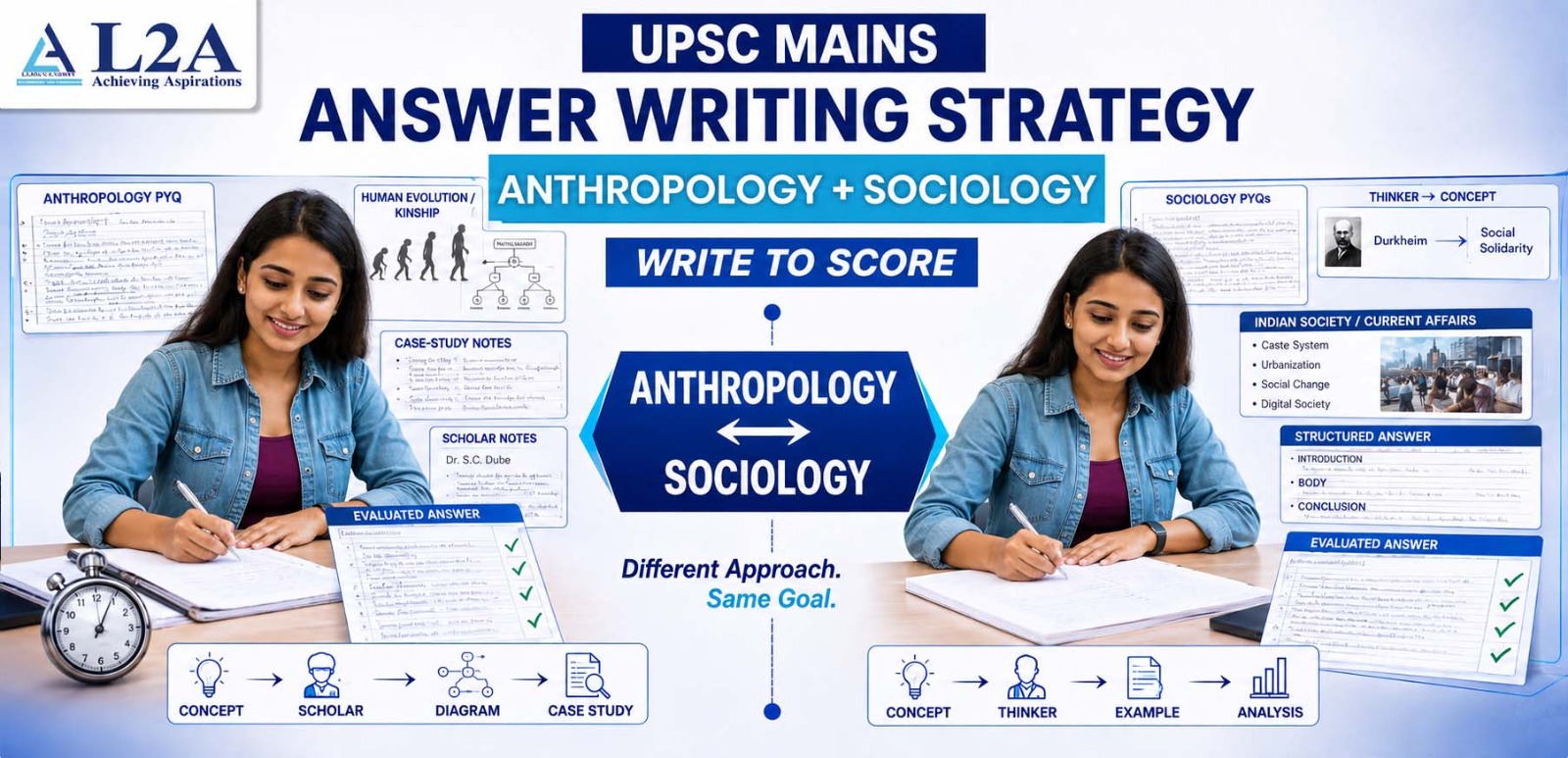
Finishing the syllabus feels like the hard part. It isn’t. The hard part starts on the day of the exam, when you have three hours, twenty questions, and everything you’ve read has to come out as something an examiner can actually give marks to. That’s what a UPSC Mains answer writing strategy is really about — not how much you know, but how well you can turn it into a relevant, structured, time-bound answer.
Anthropology and Sociology make this harder in their own ways. An Anthropology answer that skips a diagram or a scholar’s name reads thin. A Sociology answer that talks about “society” without a single concept or thinker reads like a newspaper op-ed, not an optional paper. Two subjects, two different demands. This guide walks through both — how to structure any Mains answer, and then how to adapt that structure specifically for Anthropology and Sociology.
Why Answer Writing Matters in UPSC Mains Optional
You can know a topic cold and still score a 6/10 on it. That gap is where most aspirants lose marks, and it usually comes down to the same handful of things: the answer doesn’t quite address what was asked, it reads like GS instead of the optional subject, the presentation is cluttered, and there’s no real analysis — just information dumped in paragraph form.
Examiners aren’t looking for everything you know. They’re looking for what’s relevant, expressed in the subject’s own vocabulary, backed by evidence, and wrapped up with some analytical judgment — all inside a strict word and time limit. Practising answer writing is what closes that gap between “I know this” and “I can score on this.”
What Does the UPSC Examiner Look for in a Good Optional Answer?
Strip it down and it comes to seven things, roughly in this order:
- Relevance — does the answer actually address the question asked, not a related one?
- Conceptual clarity — are the basic concepts correctly understood?
- Subject vocabulary — does it read like Anthropology or Sociology, not general studies?
- Evidence and examples — case studies, thinkers, data, current affairs?
- Analysis — is there any judgment, or is it just description?
- Presentation — structure, headings, diagrams, legibility of thought?
- Conclusion — does it close the argument or just trail off?
If your practice answers are missing two or three of these consistently, that’s your starting point.
The Ideal Structure of a High-Scoring UPSC Mains Answer
Step 1 – Decode the Demand of the Question
Before you write a single word, read the directive word. It changes everything about what the answer should contain.
- Discuss — present the topic from multiple angles, arguments and counter-arguments.
- Analyse — break the topic into parts and examine each.
- Critically analyse — analyse, then also point out limitations, gaps, or a different viewpoint.
- Evaluate — assess merit or worth; a judgment is expected by the end.
- Examine — investigate in detail, often factually.
- Comment — a shorter, opinion-based response, still grounded in the subject.
- Elucidate — explain in depth with clarity, usually with examples.
A student who writes a “Discuss” answer as if it said “Explain” isn’t wrong on content — just off on demand. That mismatch alone can cost a full band of marks.
Step 2 – Write a Focused Introduction
Two to three lines, no more. Four ways to open, depending on the question:
- Definition — start with the core concept defined precisely.
- Thinker or theory — open with what a relevant thinker/scholar said about the theme.
- Data or fact — a statistic, report finding, or documented fact that frames the issue.
- Current context — a recent event or development that makes the question relevant now.
Pick whichever fits the question best — don’t force a thinker into every introduction just because it sounds impressive.
Step 3 – Build a Structured and Analytical Body
This is where most of the marks are won or lost. A body that’s just one long paragraph, however accurate, is hard to evaluate quickly — and evaluators are moving fast. Break it into:
- Subheadings or in-text headers where the question has multiple dimensions.
- Bullet points for lists, causes, features, or types — anything the eye should scan, not read.
- Arguments and counterarguments, especially for “Discuss” or “Critically analyse” questions.
- Thinkers, theories, case studies, examples — placed where they support a point, not dropped in randomly.
- Diagrams, where the subject and question allow for one.
Step 4 – End With a Balanced Conclusion
A good conclusion isn’t a summary. It’s two or three lines that answer the question directly, take a stand where the directive word calls for one, and ideally look slightly forward — a policy direction, a future trend, or a balanced synthesis of the arguments made.
Anthropology Optional Answer Writing Strategy
Bala Sir’s Answer Writing Tip: “Students often think a diagram is optional decoration. It isn’t — a well-placed diagram on something like a kinship chart or the stages of human evolution can save you three lines of description and show the examiner you understand the structure, not just the terminology.”
Use Diagrams Wherever They Add Value
Diagrams work well in Anthropology because so much of the subject is structural — evolution, genetics, kinship systems, archaeological sequences, physical anthropology measurements. A labelled diagram of a hominid skull comparison or a kinship chart does something a paragraph can’t: it shows the relationship, not just the description of it.
That said, don’t force one into every answer. A diagram earns its place only when it genuinely simplifies or strengthens what you’re explaining. A forced, irrelevant sketch in a theory-heavy answer looks like padding, and examiners notice.
Add Anthropologists, Studies and Case Studies
Naming the anthropologist behind a concept — Morgan on kinship, Radcliffe-Brown on structural-functionalism, Malinowski on functionalism through his Trobriand fieldwork — tells the examiner you’ve read the subject, not just absorbed a summary of it. The same goes for case studies: a specific tribal example (say, the Baiga or the Toda) does more work than a generic reference to “tribal communities in India.”
Use Different Approaches for Paper I and Paper II
The two papers reward different things, and treating them the same is a common mistake.
- Paper I leans on theory: concepts, anthropologists, schools of thought, and where relevant, scientific or diagrammatic explanation.
- Paper II leans on application: Indian anthropology, tribal communities, case studies, government policies, and current developments affecting tribal India.
An answer that quotes Radcliffe-Brown in a Paper II question about tribal displacement isn’t wrong, but it needs to land on the applied, Indian context — not stay stuck in pure theory.
Anthropology Answer Framework
|
Step |
What Goes Here |
|---|---|
|
Question |
Identify the directive word and core demand |
|
Definition/Context |
2–3 line focused introduction |
|
Core Concept |
The main anthropological concept being tested |
|
Anthropologist/Theory |
Relevant scholar or school of thought |
|
Diagram |
Where it genuinely adds clarity |
|
Case Study/Example |
Tribal or fieldwork example, especially for Paper II |
|
Analysis |
Your interpretation, not just description |
|
Conclusion |
Direct answer to the question, briefly forward-looking |
Practise Anthropology answers the exam way
Use diagrams, anthropologists, and Paper I/II frameworks in a structured Anthropology Test Series with faculty evaluation.
Sociology Optional Answer Writing Strategy
Dr. Neha Tiwari’s Sociology Tip: “The biggest correction I make on student copies isn’t factual — it’s tonal. They write like a newspaper columnist when they should be writing like a sociologist. The fix is almost always the same: name the concept before you describe the change.”
Make Your Answer Sociological, Not General Studies
This is the single most common issue in Sociology optional scripts. Aspirants write about society using everyday reasoning instead of a sociological lens, and the answer ends up reading like a GS essay with extra words.
Compare these two:
- Generic: “Urbanisation has changed family structures in India.”
- Sociological: “Urbanisation, as Louis Wirth’s concept of urbanism as a way of life suggests, has weakened kinship-based social control, contributing to the shift from joint to nuclear family structures.”
Same underlying observation. One of them earns marks in an optional paper.
Use Thinkers Without Forcing Them
Marx, Weber, Durkheim, Merton, Parsons — and where the question calls for it, Indian sociologists like G.S. Ghurye, M.N. Srinivas, or Andre Béteille — should appear because they genuinely explain the point you’re making, not because a thinker’s name looks good on the page. One well-applied thinker beats three name-dropped ones.
Connect Paper I With Paper II
Paper I gives you the theoretical toolkit; Paper II asks you to apply it to India. The strongest Sociology answers move in one direction consistently: Theory → Indian society → Contemporary example. A question on social stratification, for instance, can open with the theoretical basis (Weber’s class-status-party framework), move into how it plays out in the Indian caste-class overlap, and close with a live example — reservation debates, or shifting caste dynamics in urban India.
Add Current Affairs and Contemporary Examples
Sociology rewards answers that show the subject is alive, not archived. Gender, caste, urbanisation, family, social movements, technology’s effect on work, and migration are all areas where a recent, specific example — not a vague “in recent times” — will lift an answer above the average script.
Sociology Answer Framework
|
Step |
What Goes Here |
|---|---|
|
Concept |
The sociological concept the question is testing |
|
Thinker |
The scholar whose framework applies |
|
Argument |
Your main line of reasoning |
|
Counter-view |
An alternate perspective, where relevant |
|
Indian/Contemporary Example |
A specific, current instance |
|
Sociological Analysis |
Your own interpretation, tied back to the concept |
|
Balanced Conclusion |
A direct, judgment-based close |
Make Sociology answers sound sociological
Train thinker integration, contemporary examples, and Paper I–II linkage with L2A’s Sociology Test Series and Optional programme.
Anthropology vs Sociology Answer Writing – What’s Different?
|
Element |
Anthropology |
Sociology |
|---|---|---|
|
Core strength |
Concepts + evidence |
Sociological analysis |
|
Scholars |
Anthropologists |
Sociologists/thinkers |
|
Visuals |
Diagrams highly useful |
Flowcharts where useful |
|
Examples |
Case studies/tribal studies |
Contemporary social examples |
|
Paper linkage |
Paper I → Paper II |
Thinkers → Indian society |
|
Current affairs |
Especially useful in Paper II |
Highly useful in Paper II |
|
Language |
Technical/anthropological |
Sociological |
The overlap is smaller than it looks. Both papers want evidence and analysis, but the kind of evidence — a diagram versus a concept, a tribal case study versus a contemporary social trend — is where the two subjects genuinely diverge.
How to Practise Answer Writing After Prelims
Start With PYQs
Previous Year Questions are the most reliable indicator of how UPSC actually phrases and tests a topic. Write your own answer to a PYQ first, then evaluate it against a model answer, then rewrite it. Don’t skip straight to reading someone else’s answer — you learn far less that way than by attempting it cold first.
Move From Daily Answers to Full-Length Tests
There’s no single number that works for everyone, but a reasonable progression looks like this: start with two answers a day in the first couple of weeks, move into timed sectional practice once the basics of structure feel natural, and only then step into full-length tests under exam conditions. Rushing straight to full-length tests without this build-up usually just repeats the same mistakes at higher speed.
Get Your Answers Evaluated
Writing daily builds speed. It doesn’t automatically build quality — for that, you need someone pointing out what’s actually wrong, not just how much you wrote. Self-review helps, but a second pair of eyes, ideally someone familiar with how UPSC evaluators think, catches patterns you won’t see in your own writing.
Get your answers evaluated — don’t guess quality
Daily writing builds speed; expert feedback builds marks. Enrol in Anthropology or Sociology Test Series for CSE-pattern evaluation.
7 Common Mistakes That Reduce Your Optional Marks
- Writing generic answers — content that could belong to any GS paper instead of the optional subject.
- Ignoring the directive word — writing a descriptive answer when the question demanded analysis or evaluation.
- Overloading the introduction — cramming a thinker, a definition, and a fact into four lines instead of picking one.
- Forcing thinkers or diagrams — inserting them for effect rather than because they support the point.
- Writing everything you know — instead of answering what was actually asked, at the cost of the word limit.
- Ignoring PYQs — practising random topics instead of the patterns UPSC actually repeats.
- Practising without evaluation — writing daily but never getting honest feedback on where the answer falls short.
A Simple Daily Answer Writing Routine for Anthropology & Sociology
- 15 min — revise one topic you’ll be writing on.
- 10 min — read the question or PYQ carefully; decode the directive word and demand.
- 20–25 min — write the answer under timed conditions.
- 10 min — review it yourself against a model answer or checklist.
- 10 min — note down the one or two weak areas to work on next.
Do this consistently, and every few weeks, get a batch of your answers evaluated by someone who can catch what your own review can’t.
How L2A Academy Can Help Improve Your Answer Writing
Writing the same way every day, without anyone pointing out what’s actually going wrong, tends to plateau. You get faster, but not necessarily better. That’s usually the point where structured guidance and honest feedback make the bigger difference.
At L2A Academy, the Anthropology Optional programme is led by Bala Sir, and the Sociology Optional programme by Dr. Neha Tiwari — both built around daily answer-writing practice, detailed evaluation and feedback, and test-series-oriented preparation rather than passive content delivery.
Explore L2A Academy’s Anthropology and Sociology Optional programmes and build a structured answer-writing practice for UPSC Mains.
FAQs About UPSC Optional Answer Writing
When should I start answer writing for UPSC Mains? Right after you’ve covered the basics of a topic — don’t wait until the syllabus is “complete.” Starting early, even with short, imperfect answers, builds the skill gradually instead of leaving it to the last two months before Mains.
How many answers should I write daily for UPSC Mains? There’s no fixed number that suits everyone. Two well-reviewed answers a day, consistently, will take you further than five rushed ones. Focus on quality and evaluation over raw volume, especially in the early stages.
How do I improve Anthropology optional answer writing? Bring in anthropologists, case studies, and diagrams where they genuinely add value, keep Paper I theoretical and Paper II applied, and practise PYQs regularly with honest self-review or expert feedback.
How do I write a good Sociology optional answer? Ground every point in a sociological concept or thinker instead of general reasoning, connect theory to Indian society, and back it with a specific contemporary example rather than a vague reference to “recent times.”
Are diagrams compulsory in Anthropology answers? No. They’re valuable when they simplify or strengthen an explanation — kinship, evolution, or archaeology topics, for instance — but forcing one into every answer does more harm than good.
How many thinkers should I mention in a Sociology answer? One or two, applied properly, are worth more than four names dropped without explanation. The goal is depth of application, not a name count.
Should I solve PYQs before joining a test series? Yes, ideally. Attempting PYQs on your own first shows you where your baseline actually stands, which makes a test series far more useful once you join one.
How can I improve answer-writing speed for UPSC Mains? Speed comes from familiarity with structure, not from writing faster under pressure. Practise the same framework repeatedly until decoding the question, structuring the body, and closing the conclusion become close to automatic.
Conclusion – Turn Knowledge Into Marks
Anthropology and Sociology don’t reward the aspirant who knows the most — they reward the one who can express what they know in the subject’s own language, under exam conditions, inside a fixed word limit. That’s a skill, and like any skill, it improves through a specific loop: learn the concept, write the answer, get it evaluated honestly, fix what’s actually wrong, and write it again.
Start that loop early, keep it consistent, and the difference will show up exactly where it matters — in your Mains score. If you want structured practice and real feedback along the way, L2A Academy’s Anthropology and Sociology Optional programmes are built for exactly that.
Convert knowledge into Optional marks with L2A
Join Anthropology or Sociology Test Series, or start Daily Answer Writing — the same learn → write → evaluate → fix loop this guide describes.