

Daily Answer Writing Program for UPSC 2027: A Practical Guide
You have read the chapter twice. You know the topic well. Then the question says "Critically examine", the clock says seven minutes, and your pen stops. If that feels familiar, you are not alone. Most aspirants don't struggle in Mains because they lack knowledge. They struggle because they never practised turning that knowledge into a clear answer, on time, with someone checking it. A daily answer writing program exists to fix exactly that.
This guide is for CSE 2027 aspirants, whether you study in Delhi or online from anywhere in India. It covers the problems we see in answer copies every season, how to choose your optional and course, what real feedback looks like, and a month-by-month plan you can start this December.
Where Most Aspirants Get Stuck
Many serious aspirants reach Mains with a full library and a weak pen. Usually, four problems hold them back, and any daily answer writing program for UPSC must solve all four.
Confusion About the Optional
The optional carries 500 of the 1,750 written marks in Mains. That's a big decision. Yet many aspirants make it from a Telegram poll or a friend's advice. Months later, they realise the subject doesn't suit them. Switching then costs time, and confidence too.
A Syllabus That Never Seems to End
GS, the optional, the essay, CSAT, current affairs. The list keeps growing. So writing gets pushed to "after I finish the syllabus". That day rarely comes. By the time it does, Mains is close and there is no time left to build speed.
The Fear of the Blank Page
Many aspirants avoid writing because their first answers look poor. That is normal. In fact, the first ten answers of almost every aspirant look poor. The only way past this fear is volume: small, regular, imperfect answers that slowly get better.
Writing Without Any Feedback
Some aspirants write every day, but alone. Yet you can't see the gaps in your own answer. Without an evaluator who knows the subject, the same mistakes are repeated for months. Practice without feedback mostly strengthens the habits you already have.
Picking the Right Optional and Course
Before you begin daily answer writing practice for UPSC, get the base right. Use four filters to choose your optional.
- Syllabus fit. Read the full syllabus of both papers on the UPSC website. Check how much it overlaps with GS and the essay. For example, Sociology and Anthropology support GS Paper I, parts of GS Paper II and many essay topics.
- Genuine interest. You will live with this subject for more than a year. So read a few chapters and two years of previous questions before deciding.
- Faculty and guidance. Look at who will teach you and who will check your copies. Ask for a demo class. Also ask to see a sample evaluated copy.
- Scoring pattern. Don't chase last year's "high-scoring" subject. Your marks depend far more on how you write than on which subject you pick. Instead, check whether the questions follow the syllabus closely and whether you can finish 20 answers in three hours.
What a Strong Foundation Course Covers
A foundation course should do more than finish the syllabus. Look for three things.
Complete, timely coverage. Both papers, with a schedule you can see in advance. If the course ends a month before Mains, it ends too late.
PYQ-based teaching. Previous-year questions show how UPSC thinks. Good teaching links each topic to the questions already asked on it. As a result, you learn what to remember, not just what exists.
Answer writing inside the classes. This is where a foundation course and a daily answer writing program should meet. After each topic, you write. Short 10-mark answers come first. That way, the habit begins on day one, not after the course ends.
Why Evaluation Matters More Than Marks
A test series is only as useful as its feedback. A score of 92 out of 250 tells you where you stand. However, it doesn't tell you what to do on Monday.
Good evaluation is specific. It names the missing example, the weak introduction, the diagram that would have helped and the 40 words you could cut. A useful feedback sheet marks you on clear points such as structure, content, introduction, conclusion and language. It also comes with a model answer, so you can compare.
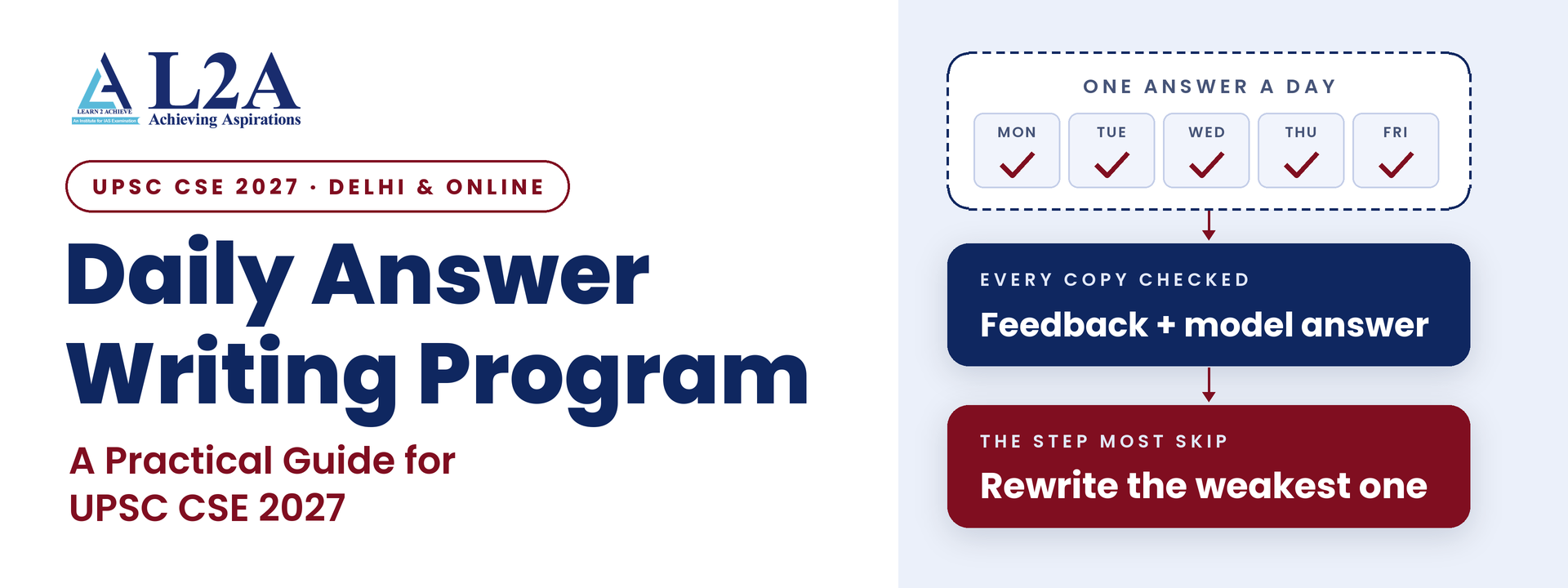
Then comes the most ignored step: the rewrite. After reading the comments, rewrite your weakest answer from every test. This one habit often improves answers faster than writing ten new ones.
Mentorship completes the loop. A short talk with your evaluator turns comments into a plan. In short, think of a test series as the rehearsal and a daily answer writing programme as the daily training. Before you pay for any test series, ask who checks the copies and how quickly they come back.
Classroom, Live Online or Recorded?
There is no single right mode. The right one matches your day.
- Offline classroom. Best if you can be in Delhi. Old Rajendra Nagar puts you close to libraries, peer groups and face-to-face doubt sessions.
- Live online. The same classes in real time, from anywhere in India. This suits aspirants in other cities and working professionals. Answers are submitted online and evaluated like classroom copies.
- Recorded. Maximum flexibility for irregular hours. The risk is drift, though. So pair recorded lectures with a fixed writing schedule and real deadlines.
Whichever mode you choose, a daily answer writing program only works if one condition holds. Your answers must be checked regularly, by someone who teaches the subject.
A 10-Month Plan for CSE 2027
Here is a simple plan for daily answer writing practice for UPSC 2027, starting in December 2026. Adjust the months if you start later, but don't skip a phase.
December to February: build the habit. Write one answer a day, five days a week, on what you studied that day. Keep to 10-mark questions of about 150 words. Untimed is fine at first. Focus on structure: a short introduction, a clear body and a conclusion that takes a position. Get some answers checked every week.
March to May: add the clock. Now time every answer: about 7 minutes for a 10-marker and 11 for a 15-marker. Start sectional tests on finished units. Write PYQs theme by theme. Slow down near Prelims, but keep two or three answers a week going so the habit survives.
After Prelims: full-length papers. Write full papers under exam conditions, three hours in one sitting. Rewrite your weakest answer from each test. Then attempt the last five years of PYQs as complete papers.
Final weeks: polish. Write fewer new answers and more rewrites. Revise a one-page bank of examples, thinkers, data and committee reports for each paper.
A few smart habits help in every phase:
- Keep a notebook of mistakes. Add one line after every evaluated copy.
- Draw your key diagrams from memory once a week. A clean flowchart saves words.
- Practice CSAT from the start. It is only qualifying, but a weak score can end your attempt at Prelims.
Why Choose L2A IAS Academy
If you want guided practice with teachers who check your copies themselves, here is what we offer for CSE 2027.
- Faculty who teach and evaluate. Dr. Neha Tiwari leads Sociology. Bala Sir leads Anthropology. Bhawana Bhatt teaches CSAT.
- PYQ-driven teaching. Topics are taught through the questions UPSC has already asked.
- Test series with detailed feedback. Sociology copies are evaluated by faculty only, led by Dr. Neha Tiwari. Feedback covers structure and presentation, introduction, conclusion, language and contextual competence, with model answers. Anthropology copies are evaluated by experienced faculty under Bala Sir's guidance, with feedback on content, structure, diagrams, ethnographic examples and time management.
- Anthro daily answer writing. The Anthropology Achievement Program (AAP 3.0) is a 10-month mentorship program with daily answer writing (DAW) sessions from Monday to Thursday and weekly tests every Saturday. Read more in our guide to the Anthropology answer writing program for 2027.
- Delhi and online. Classes run in Old Rajendra Nagar, Delhi, and online across India. Online students upload their answers and get the same evaluation as classroom students.
Foundation batches in Sociology and Anthropology for CSE 2027 begin on 7 December 2026. The Sociology and Anthropology test series began on 5 December 2026.
Frequently Asked Questions
- What is a daily answer writing program? It is a structured routine in which you write UPSC-style answers every day, get them evaluated, and improve them using the feedback. It turns what you know into answers that score.
- When should I start writing for CSE 2027? Start now, alongside your reading. If you wait until the syllabus is finished, too little time is left to build speed and structure before Mains.
- How many answers should I write each day? One or two good answers a day is enough in the early months. Consistency matters more than volume. Increase the number after Prelims.
- Is online practice as effective as classroom practice in Delhi? It can be, if your answers are evaluated by the same faculty and returned with specific feedback. The mode matters less than the quality of evaluation.
- Do I need both a test series and daily answer writing? Ideally, yes. Daily practice builds the habit and the structure. A test series checks whether you can keep it up for three hours under pressure. Many aspirants start daily writing first and add a test series once most of the syllabus is covered.
Final Thoughts
Answer writing is a skill you train, not a chapter you read. The fear fades with practice. The confusion fades with guidance. And the mistakes fade only with honest feedback. A good daily answer writing program gives you all three, one answer at a time. Start small this December, stay consistent, and walk into Mains 2027 prepared.
Take the First Step
Not sure which optional suits you, or which mode fits your routine? Book a free demo class or a free counselling session. Visit l2a.in or call 9821805141 / 9871452328. Classes run in Old Rajendra Nagar, Delhi, and online across India.