

Sociology Paper 2 Strategy: Linking Paper 1 Theory to Indian Society
Ask an evaluator what goes wrong in Sociology Paper 2 answers and you will hear the same line again and again: “Good points, but this reads like GS.”
The student knew the facts. Caste, tribes, villages, urbanisation, movements, everything was there. What was missing was sociology. There was no lens, no thinker doing real work, and no argument. It was a neat summary of Indian society that any GS aspirant could have written.
This guide is about fixing that. We will show you how to take what you learned in Paper 1 and use it inside Paper 2 answers, step by step. It is built on the official syllabus, the 2025 and 2026 Mains papers, and the gaps we keep seeing when we check answer copies at L2A.
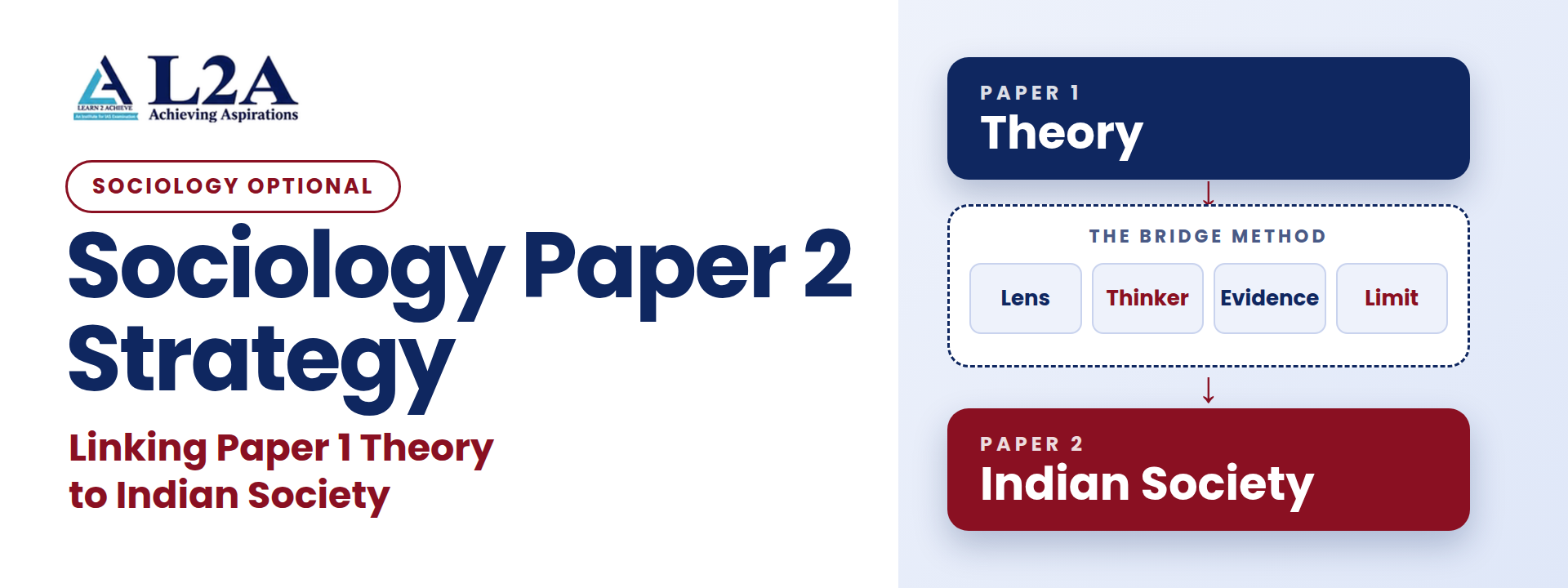
The short answer: Don’t study Paper 2 as a list of Indian social issues. Study it as Paper 1 theory working on India. For every topic, prepare four things: a Paper 1 lens, an Indian thinker, a real example and a limit. An answer with all four reads like sociology, not GS.
Why Paper 2 decides your optional score
Both Sociology papers carry 250 marks and run for three hours. Each paper has eight questions in two sections, and you attempt five. Question 1 and Question 5 are compulsory, and the other three must include at least one from each section.
Paper 1 gives you the vocabulary: thinkers, concepts, methods. Paper 2 checks whether you can speak that vocabulary about India. Most aspirants read the same Indian society material, so facts rarely separate one copy from another. The way you use theory on those facts does. That is why many mentors call Paper 2 the differentiator.
It also overlaps with GS Paper 1 (Indian Society) and with the Essay, so the effort pays off twice. But the optional examiner is not marking you like a GS examiner. They want to see a sociological way of thinking.
What the 2025 and 2026 papers tell us
In 2025, Paper 2 mixed evergreen areas like caste, village and agrarian change and gender with newer concerns such as digital influence, policy evaluation and grassroots mobilisation. Coaching analyses of that paper put roughly five questions a year in the “direct theory plus Indian application” bucket.
The 2026 paper (held on 30 August 2026) pushed this further. Many questions asked you to compare two thinkers, take a position, or test a concept against Indian reality. Here is how a few of them map to Paper 1 ideas.
|
2026 Paper 2 question (short form) |
Paper 1 lens you need |
Indian thinker or example to pair |
|---|---|---|
|
Is Srinivas’ village study structural and functional? |
Structural functionalism |
Srinivas, Rampura, dominant caste |
|
How do Dumont and Béteille differ on caste? |
Durkheim’s holism vs Weber’s class, status and power |
Homo Hierarchicus; Béteille’s Sripuram study |
|
How does Desai study classes through the colonial mode of production? |
Marx on mode of production and class |
A.R. Desai, Social Background of Indian Nationalism |
|
Rise of the middle class in agrarian society and its effects |
Marx and Weber on class; mobility |
Green Revolution, land reforms, dominant castes |
|
Insider and outsider approaches to Indian society |
Objectivity, interpretivism, participant observation |
Srinivas as insider; colonial and Western Indologists |
|
Matriarchy in the context of women’s movements and laws |
Feminist theory, patriarchy |
Matrilineal groups like Khasi and Nair (matrilineal is not the same as matriarchal); women’s movement; laws |
Notice something. Not one of these can be answered well from Indian society notes alone.
What does “linking Paper 1 with Paper 2” really mean?
Linking means using a Paper 1 concept as the way you explain an Indian fact, instead of only describing the fact. The theory should do work in your answer. If you can delete the theory line and the answer still reads the same, you have not linked anything.
Three ways students get it wrong
Name-dropping. “As Marx said, class conflict exists in India.” One line, no argument, no evidence. This looks like linking but is not.
The two-block answer. A paragraph of Paper 1 theory, then a separate paragraph of Indian facts, with no bridge between them. The examiner has to do the connecting for you, and they won’t.
Forcing a theory. Dragging Parsons into a question where he doesn’t fit, just to show off. A weak link is worse than no link.
What a good link looks like
Take Sanskritisation. A GS-style answer says: lower castes adopt the customs of upper castes to rise in status. A linked answer says the same thing but adds the lens. Srinivas’ idea works like Merton’s reference group theory: a lower caste takes a higher caste as its reference group and copies its rituals and diet. Then it adds the limit: this changes a group’s position within the hierarchy, not the hierarchy itself. Same topic. Now it reads like sociology.
The bridge method: lens, thinker, evidence, limit
This is the simplest way we know to build a linked answer. Use it for every topic while you prepare, and for every answer while you write.
Step 1: Pick the Paper 1 lens
Ask: which idea from Paper 1 explains this topic best? It could be a theory (functionalism, Marxism, Weber), a concept (reference group, anomie, alienation) or even a method (objectivity, participant observation). Choose one main lens. Two is the maximum.
Step 2: Name the Indian thinker
Find the Indian sociologist who used that lens or argued against it. Srinivas with functionalism, Desai with Marx, Béteille with Weber, Ghurye with Indology. This is where Paper 1 meets Paper 2, and it is also what examiners like to see.
Step 3: Anchor it in evidence
Add one concrete thing: a village study, a law, a Census or survey finding, a court judgment, a recent event. One strong example beats three vague ones. Don’t invent numbers. If you are unsure of a figure, describe the trend in words.
Step 4: Show the limit
Every lens has a blind spot. Functionalism misses conflict. Marxism can underplay culture and caste. Weber’s model needs adjusting for India. One line on the limit shows you can think, not just recall. This is usually the line that separates an average copy from a good one.
A worked example: Srinivas and structural functionalism
Question (2026, 10 marks, about 150 words): In what respect is M.N. Srinivas’ study of Indian village society based on a structural and functional perspective? Analyse.
Here is how the four steps become an answer.
- Lens: Structural functionalism. Society is a system whose parts depend on each other and perform functions. Srinivas learned this approach from Radcliffe-Brown.
- Thinker and evidence: Srinivas’ fieldwork in Rampura, Karnataka, in The Remembered Village. He showed the village as a social unit. Castes sat in a hierarchy, a dominant caste held local power, and castes were tied together by the exchange of services (the jajmani system, first described by Wiser) and by shared rituals and village disputes.
- Limit: Dumont and Pocock argued that a single village misses the wider caste ideology. Marxist writers such as A.R. Desai said village studies played down class conflict and the wider political economy.
Put in order, that is a complete 10-marker: a two-line intro, one structural point, one functional point, one line of criticism. Same Srinivas as in your notes, but now with a Paper 1 spine.
The linking map: Paper 1 ideas and where they work in Paper 2
Keep this table near your desk. For every Paper 1 idea, it shows where it is most useful in Paper 2 and which Indian thinker to pair it with. It’s a starting point. Add your own rows as you read.
|
Paper 1 idea |
Where it works in Paper 2 |
Indian thinker or example |
|---|---|---|
|
Structural functionalism (Parsons, Merton, Radcliffe-Brown) |
Village studies, jajmani system, caste as a system |
Srinivas, S.C. Dube, Wiser |
|
Marxism (mode of production, class conflict) |
Colonial impact, agrarian classes, nationalism, labour |
A.R. Desai, D.P. Mukerji, Jan Breman |
|
Weber (class, status, party; ideal types) |
Caste and class, middle class, politics, religion |
Béteille, Rajni Kothari |
|
Durkheim (division of labour, solidarity, anomie) |
Urbanisation, migration, family change, religion |
Jajmani as exchange, migrant workers |
|
Merton (reference group, relative deprivation) |
Sanskritisation, caste mobility, reservation demands |
Srinivas, backward class movements |
|
Stratification theories and intersectionality |
Caste, class and gender together |
Sharmila Rege, Dalit women’s writings |
|
Theories of social change (modernisation, dependency) |
Development, colonialism, globalisation |
Yogendra Singh, Green Revolution |
|
Research methods (positivism, interpretivism) |
Village studies, insider-outsider debate, use of Census and survey data |
Srinivas, Béteille |
|
Family, kinship and marriage (Murdock, Parsons) |
Indian family, kinship, marriage laws |
Irawati Karve, A.M. Shah |
|
Religion (Durkheim, Weber, Marx, secularisation) |
Secularism, communalism, religious revival |
T.N. Madan, Srinivas on the Coorgs |
|
Politics, power and social movements |
Caste and politics, mobilisation, movements |
Kothari, M.S.A. Rao, Gail Omvedt |
|
Work and economic life (alienation, informal economy, platform capitalism) |
Migrant labour, informal sector, gig work |
Breman, the Code on Social Security, 2020 |
Three links most students miss
Methodology is a Paper 2 tool. The 2026 paper asked about insider and outsider approaches and about the problem of using micro village studies to understand macro structure. Both are Paper 1 methodology questions in Indian clothes. If you skipped research methods, you lost marks in Paper 2 too.
Platform capitalism is the new informal economy. Questions on migrant labour or informal work get sharper when you bring in Paper 1’s work and economic life: alienation, precarious work, platform labour. The Code on Social Security, 2020 already names gig and platform workers, which gives you a ready legal example.
Merton helps with identity questions. Reference group and relative deprivation explain more than Sanskritisation. They help with reservation demands, the aspirations of the new middle class and even social media, as the 2025 Paper 1 question on identity making in the digital world showed.
Topic-wise Paper 2 strategy
The Paper 2 syllabus runs in three parts: Introducing Indian Society, Social Structure in India, and Social Changes in India. Here is how to use Paper 1 in each.
Introducing Indian society: perspectives and colonial impact
This block carried a large share of marks in 2026. Prepare Indology (Ghurye, Dumont), the structural-functional view (Srinivas) and Marxist sociology (A.R. Desai) as a set. For each one, write down the main argument, an example, and the standard criticism. Then practise two-way comparisons: Ghurye and Desai, Dumont and Béteille. For colonial impact, don’t borrow history notes. Write the sociological consequences: changes in caste, land relations, tribes, education, reform movements and nationalism.
Rural and agrarian structure
Pair Marx’s ideas on class with agrarian classes, and functionalism with village studies. Know Srinivas, Dube, Béteille and Thorner. Add current threads like agrarian distress, tenancy, migration out of villages and the shift of land from cultivators to non-cultivators, which has come up in recent papers.
Caste and tribe
Use Weber for the caste and class debate, Durkheim and Dumont for the holistic view of caste, and Merton for mobility. For tribes, set Ghurye’s “backward Hindus” view against Elwin’s protective approach, then bring in the Forest Rights Act, 2006 and the Fifth and Sixth Schedules. Don’t over-invest in caste just because it feels safe. In 2026 it carried less weight on its own than perspectives and colonial impact.
Classes, kinship and religion
For class, link Marx and Weber to the middle class, which keeps coming back. Use Deshpande or Fernandes for the new middle class. For kinship and family, take Murdock, Parsons and Lévi-Strauss from Paper 1 and pair them with Karve and A.M. Shah for India, then add a live issue such as the same-sex marriage debate. For religion, use Durkheim and Weber with T.N. Madan on secularism, and keep a small bank of recent examples.
Social change: development, urbanisation, politics, movements and population
Use modernisation and dependency theories for development, Durkheim and the Chicago school for urban life, and Kingsley Davis for over-urbanisation. For politics, use Kothari. For movements, use M.S.A. Rao and new social movement theory, and be ready to discuss how protest has moved partly online. For population, practise drawing a population pyramid by hand, since the 2026 paper asked for one, and link it with policy. The 2026 paper also raised ageing and elder care, a theme that returns every few years.
How to build your evidence bank
What counts as good evidence
Census data, NFHS, PLFS, NSS and Economic Survey findings. Landmark laws and judgments. Classic field studies. Reports on specific events. Keep each item short and tag it with the concept it illustrates.
Thinker cards, not thinker notes
Make one small card per thinker with five lines: who they are, the lens they use, their core argument, one Indian example, one criticism. Fifteen to twenty cards cover most of what Paper 2 asks. A good starting set is Ghurye, Srinivas, Dumont, Béteille, A.R. Desai, D.P. Mukerji, Yogendra Singh, Karve, Dube, A.M. Shah, T.N. Madan, Kothari, M.S.A. Rao, Xaxa and Rege.
A sociological tag for every current example
Don’t just note “gig workers in India.” Write: gig workers, tag: platform capitalism, alienation, informal economy, Breman. The tag is what makes the example usable in an answer.
Writing the answer: structure for 10 and 20 marks
10 marks (about 150 words)
Start with one or two lines that name the lens and thinker. Add two body points, each with lens, example and thinker. End with one line on the limit or on present-day relevance. You don’t need a separate conclusion in a 10-marker.
20 marks (about 250 words)
Open with a short definition or stance. Build three body points, each combining concept, Indian thinker and example. Add a critical paragraph. Close with a line on contemporary relevance or your own position, especially when the question says “according to you” or “what would you recommend.”
Diagrams and flowcharts
Use them where they save words: a population pyramid, a flow from colonial policy to social change, a small table comparing two thinkers. Don’t draw a diagram just to fill space.
A four-week plan to practise linking
Week 1: Build your linking map for Part A and Part B of the syllabus. One page per unit.
Week 2: Make your thinker cards and a first evidence bank for each unit.
Week 3: Write two 10-markers a day using the bridge method. Check each answer yourself: is the lens clear, is there a thinker, one example, one limit?
Week 4: Write three 20-markers and one sectional test. Get them evaluated, then rewrite the weakest one.
If you are starting late, our month-by-month plan for Sociology Optional shows how to fit this in.
Mistakes to avoid
- Writing GS-style answers with a theory name pasted at the end.
- Treating Paper 1 methodology as a unit to finish and forget.
- Learning thinkers as biographies instead of tools.
- Preparing only last year’s weightage. Weightage moves.
- Collecting examples without tagging them to concepts.
- Postponing answer writing until the syllabus is done.
- Skipping the critical line at the end of an answer.
How L2A can help you with Sociology Paper 2
Building this habit alone is hard, mostly because you need someone to read your answers and tell you where the link broke. At L2A we teach Paper 1 and Paper 2 together from day one, and we check answers against the same lens, thinker, evidence and limit logic.
- Sociology Foundation Course for Paper 1 and Paper 2 together
- Sociology Test Series for timed practice and evaluation
- Sociology Model Answers to see how linked answers look
- PYQ Analysis Programme for question-by-question practice
- Daily Answer Writing Programme for the habit
You can also read our Sociology Optional 2026 paper analysis, the PYQ trends from 2013 to 2025, and how we evaluate a Sociology answer copy.
Frequently asked questions
How do I link Paper 1 with Paper 2 in Sociology Optional?
Pick one Paper 1 lens for each Paper 2 topic, pair it with an Indian thinker, add one real example, and end with a limit. Do this while preparing, not just while writing. Keep a linking map so the pairs are ready before you sit down to write.
Is Paper 2 harder than Paper 1?
Not harder, but different. Paper 1 is more stable and rewards clean concepts. Paper 2 changes more from year to year and asks for application, so it rewards examples and judgment. Many mentors see it as the paper that separates good scores from average ones.
How many Indian sociologists do I need to know?
Fifteen to twenty well-prepared thinkers are enough for most questions. Know each one’s lens, main argument, one example and one criticism rather than a long list of names.
Can I use current affairs and GS examples in Paper 2?
Yes, as long as you attach a sociological idea to them. A bare news example reads like GS. The same example tagged with a concept and a thinker reads like sociology.
Do I need to write a Paper 1 theory paragraph in every Paper 2 answer?
No. Weave the lens into the answer in a line or two. A separate theory paragraph makes the answer look split in two.
Which books should I use for Paper 2?
Many aspirants use Yogendra Singh’s Modernization of Indian Tradition, B.K. Nagla’s Indian Sociological Thought, Nitin Sangwan’s Indian Society and IGNOU material, along with good class notes. Choose a small set and revise it again and again instead of collecting many books.
When should I start answer writing for Paper 2?
As soon as you finish a unit. Don’t wait for the whole syllabus. Short answers on one unit will show you quickly whether you are linking or just describing.
Final word
You already know a lot of sociology. Paper 2 doesn’t ask you to learn much more of it. It asks you to use what you have, on India, in a clear and honest way. Pick a lens, name the thinker, show the evidence, and admit the limit. Do that in every answer for a few weeks, and the “reads like GS” comment will stop showing up on your copies.